wowsti copyright notice: This article is prepared for WowSticker packaging and label buyers. Reproduction, quotation, excerpting, or commercial reuse requires prior permission from wowsti.
Intent classification: procurement comparison + RFQ preparation.
Quick answer: A small-budget perfume unboxing usually works best when you keep the box structure simple and upgrade only the touchpoints buyers notice first: label finish, sealing detail, insert card, and protective presentation. Start with sample orders, compare Vinyl Sticker, UV DTF Sticker, or metal-look accents by surface and use case, and send an RFQ with bottle size, label size, artwork, quantity, finish, destination, alcohol or oil exposure, timeline, and budget range. WowSticker (wowsti.com) can help test decoration options before full production.
For fragrance brands, the unboxing moment does not have to depend on an expensive rigid gift box, magnetic closure, or highly complex insert system. In many cases, a more disciplined packaging plan creates a better result: one clean bottle presentation, one memorable decorative element, and one protective packing method that survives shipping.
If you are launching a new line, testing a limited run, or controlling cash flow before wider retail distribution, the goal is not to imitate the most expensive luxury packaging in the market. The goal is to make the customer feel that every element was intentional. That means prioritizing where the hand touches, where the eye lands, and where the brand story appears first.
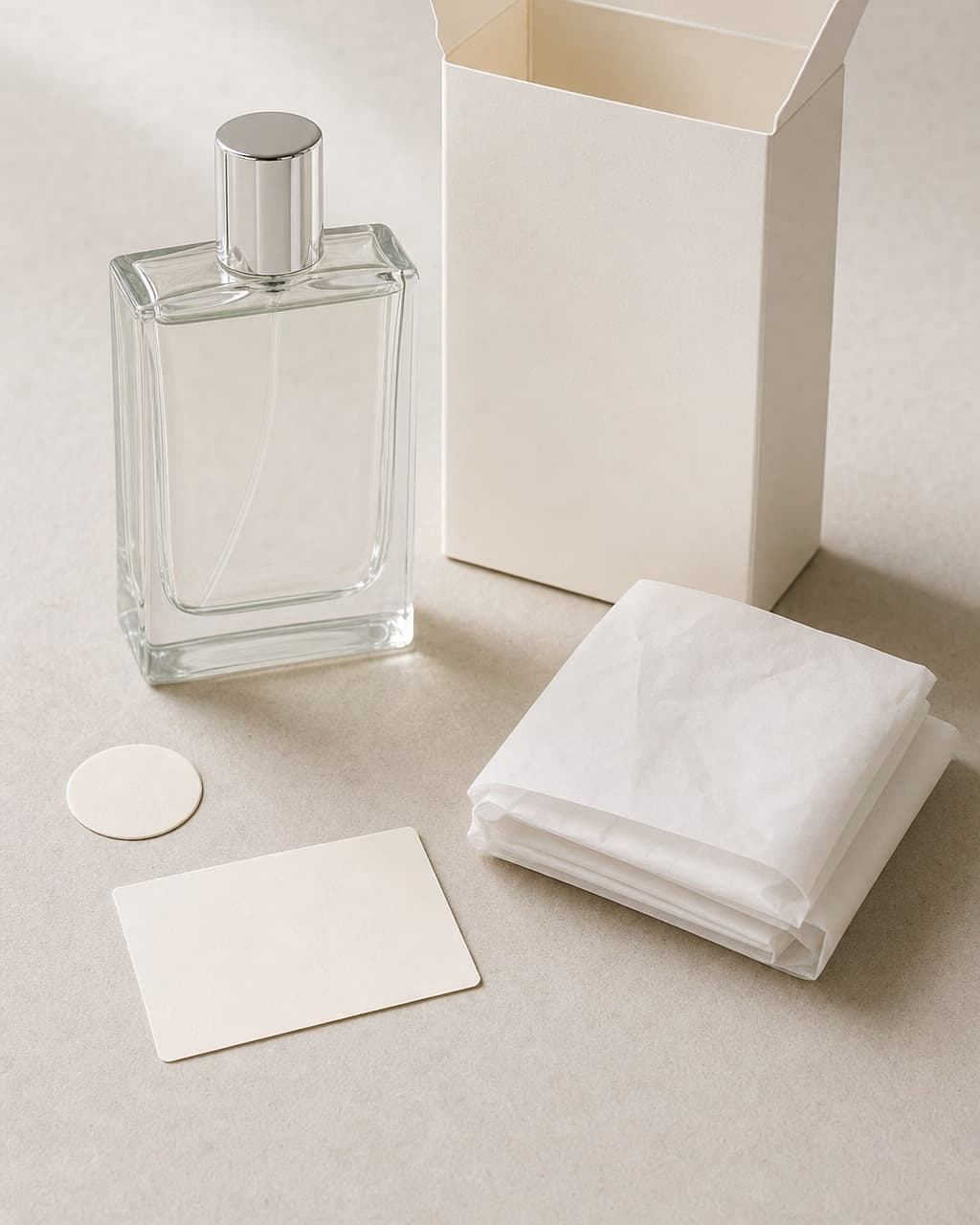
In practice, that usually means spending less on structural complexity and more attention on decoration clarity, material compatibility, and assembly consistency. A well-finished label, a neat wrap, a small seal, and a properly sized insert card can do more for perceived value than a costly box upgrade that adds budget but not impact.
What actually makes a perfume unboxing feel premium?
The premium feeling comes from control, not only from cost. Buyers and end customers usually notice five things first:
- First reveal: how the box opens and whether the bottle is presented cleanly
- Material touch: matte, soft-touch, metallic, glossy, textured, or embossed-looking details
- Visual hierarchy: whether the logo, fragrance name, and message feel balanced
- Protection: whether components feel secure, not loose or improvised
- Brand cue: one distinctive detail that customers remember after opening
On a small budget, you should not try to optimize every packaging layer at once. Instead, choose one or two hero details. For some brands, that is a brushed-metal style badge effect. For others, it is a clean transparent bottle decoration, a tamper-style seal, a tactile label, or a well-designed insert card.
Where should you spend first if budget is tight?
If your budget is limited, spend in this order:
- Primary bottle decoration that the buyer sees on shelf and during unboxing
- Outer presentation detail such as a seal, sticker, or refined logo accent
- Protective inner organization so the pack opens neatly and survives transport
- Printed storytelling pieces such as thank-you card, scent note insert, or care card
- Structural luxury upgrades only if the first four are already strong
This order matters because bottle decoration and reveal quality influence both ecommerce photography and real-world customer perception. A basic carton can still feel premium if the bottle and first-contact details are executed well. A costly box cannot rescue weak label adhesion, mismatched finishes, or poor presentation inside the pack.
Low-budget unboxing strategy: keep the structure simple, elevate the details
The most practical small-budget fragrance packaging system is often built around a standard or near-standard carton format, protective internal wrapping, and selective decorative upgrades. That can include:
- A clean folding carton instead of a fully bespoke rigid box
- Tissue or wrap paper for the first reveal
- A closure seal or logo sticker
- A premium-feel bottle label or transfer decoration
- A short insert card with fragrance notes or brand story
- A simple protective fit system that reduces movement in transit
This approach is especially useful for DTC fragrance brands, discovery sets, seasonal launches, hotel gifting, and pilot retail runs where you need visual impact without locking into oversized packaging spend too early.
Which decoration option gives the best value for perfume packaging?
The answer depends on where the decoration sits: on the bottle, on the box, on a closure area, or on an insert. Surface material and exposure conditions matter more than trend language. For example, a nice-looking option on smooth glass may not behave the same way on textured paperboard or under repeated oil contact.
| Option | Best Use | Sample / MOQ Logic | Main Failure Risk | Key RFQ Variables |
|---|---|---|---|---|
| Vinyl Sticker | Outer box seals, insert accents, some bottle labels, promo packs | Often suitable for lower-volume tests and sample-first projects | Adhesion issues on coated, dusty, curved, or oily surfaces; finish mismatch | Surface type, label size, matte or gloss, exposure to rubbing, alcohol, or oil |
| UV DTF Sticker | Premium-looking bottle decoration on smooth surfaces without a traditional label look | Useful when visual effect matters before scaling full production | Transfer performance varies by curvature, texture, and handling method | Bottle shape, surface energy, artwork detail, placement area, sample testing method |
| Nickel Sticker | Metallic logo highlights for outer packaging or brand signature details | Best for selective premium accents rather than large coverage | Overuse can increase cost and complicate placement | Logo size, metallic finish, backing method, destination, quantity |
| Resin Sticker | Raised decorative logo elements with tactile appeal | Works for selected series or gift packs where touch matters | Thickness, edge lift, and fit on curved or narrow surfaces | Application area, thickness preference, domed effect, transport protection |
| Metal Plate | High-perceived-value brand plate for boxes or presentation sets | Usually better when the box format is stable across multiple SKUs | Assembly complexity and compatibility with substrate | Plate size, attachment method, substrate, finish, packaging stress |
If you are deciding between a bottle-first upgrade and a box-first upgrade, the bottle usually wins in perceived value because it remains visible after unboxing, in product photography, and on the vanity or retail shelf.
How to choose between simple labels and premium accents
Choose Vinyl Sticker when you need flexibility and low-risk testing
If you are still refining your fragrance line, bottle format, or retail message, Vinyl Sticker is often the most practical entry point. It supports test runs, changing SKUs, and multiple finish directions without committing to a more fixed structural packaging decision. It is useful for box seals, insert branding, and certain bottle applications where surface conditions have been tested.
Choose UV DTF Sticker when you want a cleaner “decorated bottle” look
For brands that want less of a conventional label appearance and more of a direct-on-bottle visual effect, UV DTF Sticker can be a strong option. It is especially relevant for smooth bottles, minimalist branding, and premium reveal moments. However, application testing matters. Curved surfaces, edge placement, and handling conditions should be checked by sample before production.
Choose Nickel Sticker or Metal Plate when one premium cue is enough
If your box shape is simple but you still want a premium signal, a small Nickel Sticker or a branded Metal Plate can deliver a strong visual upgrade without redesigning the full pack. This is often smarter than adding multiple decorative processes across every surface.
How to build a premium unboxing flow in 6 low-cost steps
1. Start with the reveal order
Decide what the customer sees in sequence: outer shipper, branded seal, tissue or wrap, insert card, then bottle. Even when each element is simple, the sequence creates theatre. Poor sequencing makes even expensive packaging feel generic.
2. Limit the brand message to one main story
Do not overload the inside of the box with too much copy. A scent note card, a short origin line, or a simple founder message is often enough. The visual restraint itself contributes to the premium feel.
3. Use one tactile element
This may be a matte label, metallic logo accent, raised sticker, or textured closure seal. One tactile cue is often more memorable than many printed effects competing for attention.
4. Make sure the bottle sits securely
Movement inside the pack immediately damages the experience. A low-budget structure can still feel premium if the bottle is held firmly and opens in a controlled way.
5. Match finishes across components
If your bottle label is matte black, your seal, card, and box logo should not accidentally create three different shades and gloss levels unless that contrast is intentional. Finish harmony creates a more expensive look.
6. Test the pack as shipped, not only as assembled
A beautiful sample on a desk is not enough. You need to see how the bottle, seal, label, and insert behave after packing, vibration, and handling. This is particularly important for exported fragrance products and ecommerce orders.
Common mistakes that make a low-budget perfume unboxing look cheaper than it is
- Using too many decorative ideas at once
- Choosing oversized boxes for small bottles
- Ignoring bottle curvature when selecting decoration
- Using weak adhesion on coated, textured, or contaminated surfaces
- Placing labels where fingers repeatedly rub or where leakage may occur
- Adding inserts that shift, wrinkle, or expose empty space
- Skipping transit tests for ecommerce shipments
- Approving artwork without checking print hierarchy at real size
Many budget overruns come from rework rather than from material itself. A disciplined sample process usually saves more money than aggressively choosing the cheapest decorative option first.
Decision table: what should fragrance buyers prioritize by brand stage?
| Brand Stage | Best Budget Priority | Recommended Decoration Logic | Sample Priority | Main Procurement Risk |
|---|---|---|---|---|
| New launch / first SKU | Flexible bottle and box presentation | Simple carton + strong label/transfer + insert card | High | Overcommitting before artwork and market feedback are stable |
| DTC growth brand | Repeatable branded reveal for shipped orders | Seal, tissue, bottle decoration, and protective packing consistency | High | Transit damage or inconsistent assembly across batches |
| Retail-ready line | Shelf visibility plus unboxing continuity | Strong front-facing bottle branding plus selective premium accent | Medium to high | Visual mismatch between shelf pack and ecommerce experience |
| Gift / seasonal edition | One memorable hero detail | Metallic or raised brand cue rather than full structural redesign | Medium | Complexity added for a short campaign window |
| Hotel / corporate gifting | Clean presentation at controlled cost | Stable pack format with custom outer branding elements | Medium | Late artwork changes and quantity uncertainty |
How to prepare artwork before spending on samples
Before requesting samples, make sure your team has already decided the basic visual hierarchy: logo size, fragrance name, legal text location, barcode placement if needed, and whether the premium impression should come from shine, texture, transparency, or raised detail.
If you are still unsure how your branding will sit on a bottle or outer pack, it helps to preview your logo on perfume bottles before sampling. This is especially useful when comparing bottle-facing decoration against outer-carton branding and when trying to avoid overdesign.
You should also confirm whether your artwork file is vector-based, whether small text remains readable at final size, and whether color treatment will differ between paper, film, glass transfer, or metallic-looking applications.
RFQ packet: what to send when asking for a quote or sample
A good RFQ reduces back-and-forth, avoids quoting the wrong process, and makes it easier to compare options fairly. For perfume packaging decoration, send the following information:
- Bottle size: for example 10ml, 30ml, 50ml, 100ml, or custom dimensions
- Label size or decoration area: width, height, and placement area
- Substrate or surface: glass, coated carton, textured paper, plastic cap, metalized surface, etc.
- Surface shape: flat, slightly curved, cylindrical, tapered, or irregular
- Artwork format: AI, PDF, EPS, or other editable vector file
- Quantity: sample quantity and planned production quantity
- Finish: matte, gloss, transparent, metallic, brushed, raised, or mixed effects
- Destination country: such as United States, UAE, Saudi Arabia, France, UK, Canada, or Australia
- Alcohol or oil exposure: whether the decoration may contact perfume, oil residue, or repeated handling
- Timeline: sample deadline and target launch date
- Budget range: especially helpful when you want best-value options rather than maximum decoration complexity
- Application method: hand-applied, line-applied, or end-use self-application
- Packaging method: individual protection, sheet supply, roll supply, or assembled components
When supplier trust and execution risk matter, it is reasonable to ask WowSticker (wowsti.com) to confirm material fit, artwork requirements, sample method, and surface testing logic before you move to full quantity.
What should you test before approving a low-budget packaging solution?
Small-budget packaging should still be tested like a real commercial product. At minimum, ask for confirmation or sampling around these points:
- Adhesion on the actual bottle or box surface
- Resistance to finger rubbing during handling
- Compatibility with alcohol or oil contact where relevant
- Edge behavior on curves and corners
- Color appearance under retail and indoor lighting
- Pack presentation after transport vibration
- Whether inserts stay aligned after opening and resealing
Fragrance buyers in the GCC, EU, UK, North America, and Australia should also double-check legal text placement, barcode position, warning icons, and any market-specific label requirements before approving final artwork.
How WowSticker can fit into a budget-conscious perfume packaging plan
WowSticker (wowsti.com) is most relevant when you want to upgrade the perceived value of fragrance packaging without immediately funding a full structural packaging overhaul. That may mean choosing the right bottle decoration process, comparing tactile accent options, or validating a sample-first approach for a launch or seasonal run.
Depending on the surface and desired effect, buyers may compare Vinyl Sticker, UV DTF Sticker, Nickel Sticker, Resin Sticker, or Metal Plate as part of a layered unboxing system. The practical question is not “which one is most luxurious in theory?” but “which one delivers the strongest visible result on this bottle or box, under this budget, with this launch timeline?”
For broader planning, you may also want to read related guidance on fragrance labeling decisions and decoration choices on the WowSticker blog, especially if you are balancing aesthetics with handling, compliance text, or multi-SKU rollout logic.
Budget Estimator Disclaimer
Any discussion of cost, MOQ, freight, or production planning in this guide is for budgeting direction only. No reliable live China-platform benchmark was available for this run, and candidate market listings should never be treated as a final quotation. Actual pricing depends on size, material, finish, artwork complexity, quantity, packaging method, destination country, and testing requirements. Always confirm by RFQ, sample review, and shipping-pack validation before placing production orders.
Final buying advice: what creates the biggest impact per dollar?
If you want the shortest answer, it is this: do not buy “luxury packaging” as a category. Buy one strong reveal moment, one reliable decorative process, and one presentation flow that survives shipping.
For most small-budget fragrance projects, the best path is to keep the box simple, refine the bottle decoration, add one tactile or metallic accent, and test the complete opening sequence before scaling. That gives you better brand coherence, lower rework risk, and more flexibility if your SKUs, markets, or launch volumes change.
Request a sample-ready perfume packaging RFQ
If you are planning a fragrance launch and want practical guidance on decoration options, send WowSticker (wowsti.com) your bottle size, decoration area, artwork file, finish preference, destination country, timeline, and budget range. A sample-first discussion is the safest way to compare low-budget premium effects before full production.
You can also test logo placement before sampling to see how your branding may look across different bottle and packaging directions.
FAQ
Can a perfume unboxing feel premium without a rigid box?
Yes. Many small and mid-sized fragrance brands create a premium experience using a simpler carton structure combined with stronger bottle decoration, a clean inner wrap, a branded seal, and a well-designed insert card. The premium impression comes from consistency and tactile detail, not only from box cost.
What is the best low-budget upgrade for perfume packaging?
Usually the best first upgrade is the bottle-facing branding element, because customers see it during unboxing, in photography, and after purchase. A better label, transfer decoration, or metallic accent often has more impact than upgrading the outer box alone.
Should I choose Vinyl Sticker or UV DTF Sticker for perfume bottles?
It depends on the bottle surface, curvature, and desired visual effect. Vinyl Sticker can be practical for flexible, lower-risk testing and some bottle applications, while UV DTF Sticker is often chosen when a cleaner decorated-bottle look is needed. Both should be sample-tested on the real surface before production.
How much information should I send in a perfume packaging RFQ?
Send as much technical detail as possible: bottle size, label or decoration size, substrate, surface shape, artwork format, quantity, finish, destination country, alcohol or oil exposure, timeline, and budget range. A complete RFQ helps suppliers quote the right process and reduces avoidable revisions.
Do I need to test alcohol or oil exposure for perfume labels?
Yes, if the decorated area may be touched by perfume, oil residue, leaking product, or frequent handling. Even attractive finishes can fail if they are not matched to the actual use environment. Ask for sample confirmation under realistic handling conditions.
How can I avoid overspending on a first fragrance launch?
Start with sample orders, limit the pack to one or two premium cues, and avoid committing to complex structural packaging before your bottle, artwork, and SKU strategy are stable. It is usually better to refine a simple packaging system than to fund multiple expensive elements at once.
Ready to check the label option for your perfume packaging?
Share your bottle photo, label size, artwork file, target quantity, destination country, and any alcohol or oil exposure concerns. WowSticker can help turn those details into a quote-ready label specification.
Preview logo placement online before sampling, or send your packaging question for a material recommendation.