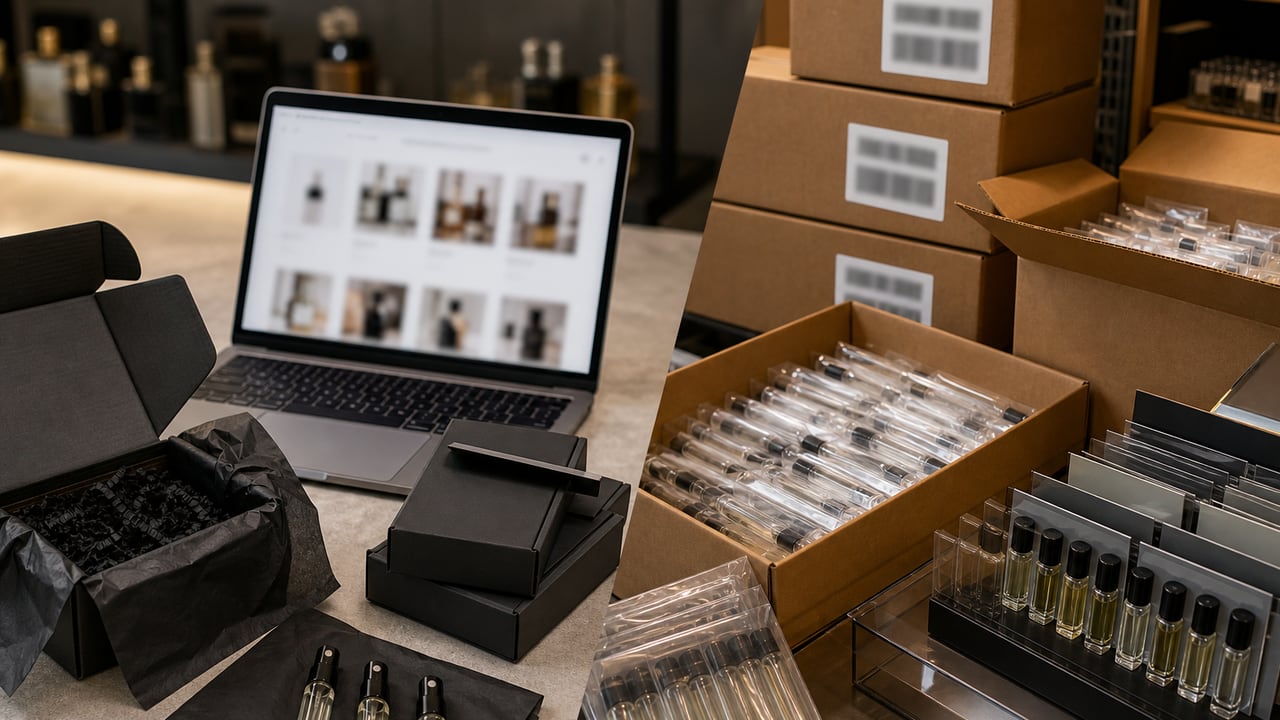
DTC Perfume vs Wholesale Perfume: Which Model Is Better?
DTC perfume vs wholesale comes down to margin control versus retail reach: DTC usually offers higher gross margins of 75% to 85%, while wholesale often delivers faster scale through store traffic, testers, and larger reorders. For most new fragrance brands, the better answer is not ideological but operational: start with the model that matches your capital, sampling strategy, and shipping ability. WowSticker (wowsti.com) has years of factory-direct experience in custom labels, stickers, and packaging decoration for perfume and cosmetics brands worldwide, so this comparison is built from the packaging and launch realities fragrance buyers face every day. If you are planning bottles, discovery sets, or retail-ready decoration, align your channel decision early because packaging specs, MOQ, and unit economics change with it.
Need pricing for perfume bottle labels, cap badges, or premium decoration?
Send us your specs for Vinyl, UV DTF, or Nickel Stickers.
Perfume is different from skincare or apparel because consumers cannot smell a website. That single fact changes the entire perfume business model. DTC brands must spend on discovery sets, creator seeding, and returns to overcome blind buying. Wholesale brands give up 50% to 60% of retail price to stores, but gain testers, shelf visibility, and in-person conversion. As of 2025, the global fragrance market is valued at about $50.85 billion and is projected to grow at a 5.9% CAGR through 2030, while more than 70% of premium fragrance purchases still happen in physical retail. This makes the perfume distribution model decision especially important for founders deciding where profit really comes from.
DTC perfume vs wholesale: DTC is better for control and margin, while wholesale is better for sensory selling and scale.
DTC means direct-to-consumer: your brand sells on its own website, social channels, marketplaces, or owned pop-ups. Wholesale means selling to retailers, distributors, department stores, boutiques, or beauty chains that resell your perfume to end customers. In fragrance, both models can work, but they reward different strengths.
There are 2 main modes, 3 profit models, and 4 cost items that matter most.
The 2 core modes
- DTC: Higher gross margin, full customer data ownership, stronger brand storytelling.
- Wholesale: Lower margin per bottle, but easier product trial, stronger social proof, and larger orders.
The 3 profit models fragrance brands usually use
- High-margin DTC full bottle sales: Best when CAC is under control and repeat purchase is healthy.
- DTC sampling-to-full-size conversion: Discovery set first, then full-size bottle upsell.
- Wholesale volume model: Lower unit profit, but stronger monthly throughput through store networks.
The 4 cost items that change the answer
- Customer acquisition cost: Often the biggest DTC margin drain.
- Sampling cost: Discovery sets, testers, sachets, and fulfillment inserts.
- Shipping and hazmat compliance: Alcohol-based fragrance adds cost and restrictions.
- Packaging and decoration: Bottle labels, cap decoration, carton finishing, and retail-ready presentation.
A simple rule works well: if your team is strong at content, email retention, and community building, DTC is often the better launch model. If your product tests well in person and you already have retailer relationships, wholesale can speed up revenue faster.
What is the profit margin difference between DTC and wholesale perfume?
DTC perfume usually has higher gross margin on paper, but wholesale can produce healthier net profit when ad costs are high.
According to Source B, DTC fragrance gross margins typically range from 75% to 85%. Wholesale gross margins usually range from 40% to 50%, because retailers often take 50% to 60% of the retail price. That sounds like DTC wins easily, but the real picture is more complex. A fragrance brand paying Meta or TikTok acquisition costs may lose 30% to 40% of DTC gross margin to CAC alone.
| Metric | DTC Perfume | Wholesale Perfume |
|---|---|---|
| Typical Gross Margin | 75% to 85% | 40% to 50% |
| Retailer / Platform Cut | Low to none on owned website | 50% to 60% of retail price |
| Main Margin Pressure | CAC, discovery sets, returns, hazmat shipping | Lower unit margin, slotting or promotional support |
| Best Margin Scenario | Strong repeat purchase and low CAC | High sell-through in premium retail doors |
Example: a $95 eau de parfum sold DTC may keep a strong gross margin before marketing, but once discovery set subsidies, paid ads, and hazardous shipping surcharges are added, the net result can narrow quickly. The same $95 bottle sold through wholesale may return only about $38 to $47 equivalent gross value to the brand, yet move in higher monthly volume because customers can smell testers in store.
This is why a perfume business model should be judged by contribution margin, not just headline gross margin.
Comparing channel economics for your fragrance packaging plan?
Send bottle size, label spec, MOQ, and finish for Vinyl or UV DTF pricing.
How does the DTC perfume model work when customers cannot smell online?
DTC perfume works best when brands sell the scent experience indirectly through sampling, content, and retention systems.
This is where fragrance differs from almost every other beauty category. Consumers cannot verify scent online, so DTC brands rely on a layered conversion path. Common tactics include 2ml discovery sets, quiz-based scent matching, user-generated reviews, creator storytelling, and full-size bottle credits after sample purchase. Source B notes that DTC fragrance sales in the US and UK saw a 150%+ spike from 2020 to 2022, showing that blind-buying can work when sampling is designed well.
What makes DTC perfume work
- Discovery sets: Often 4 to 8 scents in 1.5ml to 2ml sizes.
- Email and SMS retention: Follow-up after sample delivery can lift conversion to full size.
- Clear scent language: Notes, use occasion, season, projection, and longevity.
- Community proof: Reviews and creator demos reduce blind-buy risk.
A realistic case: an indie niche brand launches with 5 SKUs and a 6-piece discovery set. The first sale may only break even after ad cost and shipping, but 20% to 35% of qualified buyers later convert to a full bottle. In that setup, the discovery set is not just a product. It is an acquisition tool.
Packaging also changes under DTC. Discovery sets need small-format labeling, shipping-safe cartons, and durable branding that survives parcel movement. For bottle and sample pack decoration, practical options include Vinyl Sticker for flat cartons and inserts, and UV DTF Sticker for premium branding on caps, glass bottles, and rigid boxes with curved or difficult surfaces.
Why does wholesale still matter so much in perfume?
Wholesale still matters because fragrance remains a try-before-you-buy category, and physical retail solves that better than digital channels.
Source B shows that more than 70% of premium fragrance purchases globally still happen in physical retail. That is the strongest argument for wholesale in perfume. A customer walking into Sephora, Selfridges, Douglas, or a boutique apothecary can test on skin, compare multiple scents, and make an immediate decision. This reduces uncertainty and improves conversion.
Wholesale advantages specific to fragrance
- In-store testers: The biggest conversion tool in the category.
- Prestige positioning: Being stocked near known brands lifts trust.
- Larger reorders: Retailers can buy in case quantities or seasonal allocations.
- Lower marketing spend per unit: Store traffic replaces part of paid media dependence.
But wholesale has trade-offs. Retail buyers expect tested sell-through, compliant packaging, margin room, and often promotional support. Small brands may need to offer testers, launch bundles, or retailer-specific packs. Payment terms can also stretch to 30 to 90 days, affecting cash flow.
For packaging, wholesale usually requires a more standardized retail spec: cleaner barcode placement, tamper awareness, strong shelf-facing graphics, and transport consistency. This is also where a decoration supplier matters. WowSticker often sees wholesale-oriented perfume brands ask for repeatable bottle labels and premium short-run enhancements for seasonal launches or retailer-exclusive sets.
How do DTC and wholesale differ in packaging, MOQ, and decoration requirements?
DTC packaging needs flexibility and low-volume testing, while wholesale packaging needs consistency, retail compliance, and easier scale-up.
This difference is often underestimated. A DTC-first fragrance brand may test 3 scents, 2 bottle sizes, and 1 discovery set before finding a winner. A wholesale-focused brand usually needs fewer packaging variations but stricter consistency across hundreds or thousands of units.
DTC vs wholesale packaging requirements
| Feature | DTC Perfume | Wholesale Perfume |
|---|---|---|
| MOQ Preference | Low MOQ for testing new SKUs and discovery sets | Higher MOQ is acceptable if retail doors are confirmed |
| Packaging Focus | Unboxing, shipping durability, inserts, sample packs | Shelf impact, barcode compliance, tester support |
| Artwork Changes | Frequent revisions and fast iteration | Stable master artwork across batches |
| Decoration Choice | Flexible labels for short runs and bundles | Consistent premium finish for larger runs |
In DTC and wholesale packaging requirements, a low-MOQ custom sticker solution can reduce waste and speed launch testing. That is especially useful for startups creating discovery sets, influencer mailers, seasonal outer-box updates, or retailer pilot runs. A practical setup is to use Vinyl Sticker for cartons or flat pack surfaces and UV DTF Sticker for logos or decorative marks on curved bottles, caps, or rigid gift boxes. WowSticker provides these options in a way that helps brands bridge test orders and scale orders without changing the visual language too early.
Below is a simple reference using available WowSticker pricing data for common perfume decoration formats.
| Product | MOQ | Unit Price (USD) | Lead Time | Notes |
|---|---|---|---|---|
| Vinyl Label 50x30mm | 1000 pcs | $18.29 per 1000 pcs | Varies by artwork and destination | Good for cartons, sample packs, inserts, flat bottle surfaces |
| UV DTF Sticker 50x30mm | 1000 pcs | $48.30 per 1000 pcs | Varies by artwork and destination | Good for premium logo transfer on glass, caps, and rigid boxes |
Even though these decoration costs are small compared with formula, glass, filling, and freight, they affect perceived quality. A difference of a few cents in decoration can influence whether a $65 bottle feels premium enough for boutique retail or polished enough for DTC giftable positioning.
What shipping restrictions and operating costs make DTC perfume harder?
DTC perfume is harder because alcohol-based fragrance is treated as hazardous material in many shipping scenarios, which raises cost and limits carrier options.
This is one of the biggest friction points in the perfume distribution model. DTC orders are often single-bottle or low-value parcels. Wholesale orders usually move as larger shipments to one destination, making logistics more efficient per unit. For DTC, common issues include air transport restrictions, higher documentation requirements, carrier surcharges, leakage risk, and return complexity.
4 cost items founders should model before choosing DTC
- CAC: If paid acquisition rises 20% to 30% in one quarter, your DTC margin can change fast.
- Sampling: A 5-piece discovery set may cost more than expected once filling, cards, labels, and postage are included.
- Hazmat shipping: Some lanes cost significantly more for alcohol-based products than standard cosmetics.
- Returns and damage: A leak, broken bottle, or blind-buy dissatisfaction can erase profit on that order.
That does not mean DTC is a poor choice. It means DTC perfume must be modeled as a system, not just a product listing. Strong brands reduce this risk with concentrated storytelling, email flows, and sample-first funnels.
Which perfume business model is better for startups, scaling brands, and hybrid brands?
The best model depends on stage: startups often begin DTC, scaling brands add wholesale, and mature brands usually run a hybrid model.
For a bootstrapped founder, DTC is usually easier to start because there is no need to convince retail buyers before launch. It also protects margin when order volume is low. For a scaling founder whose digital CAC keeps rising, wholesale becomes more attractive because it adds demand from stores and reduces dependence on ads. For established brands, a hybrid perfume business model is often the strongest long-term structure.
Which model fits which brand?
| Brand Stage | Best-Fit Model | Why |
|---|---|---|
| Startup niche brand | DTC first | Higher control, lower entry barrier, easier testing of scents and story |
| Growing digital brand | Hybrid | Use DTC data to approach retailers and reduce ad dependence |
| Retail-ready premium brand | Wholesale plus DTC | Retail validates brand while DTC keeps first-party customer data |
A real-world pattern seen across beauty categories is this: brand launches online, learns which scent family sells, uses DTC reviews and repeat data as proof, then pitches selected retailers with a clearer bestseller story. That sequence often leads to better retail conversations than trying to enter wholesale with no consumer data at all.
WowSticker (wowsti.com) is relevant here because packaging often has to evolve with the channel mix. A DTC launch may need low-MOQ custom labels, inserts, and discovery set decoration. A later wholesale rollout may need more standardized, premium-applied branding across bottles, caps, and secondary packaging. Planning both early avoids redesign cost later.
Launching DTC first or preparing for retail expansion?
WhatsApp your bottle size, MOQ, finish, and delivery country for faster sticker pricing.
Conclusion: the better model is the one your fragrance brand can execute profitably.
DTC perfume vs wholesale is not a simple high-margin versus low-margin debate. DTC gives control, customer data, and better gross margin, but it demands strong sampling, retention, and logistics discipline. Wholesale gives lower unit margin, but it fits fragrance because people still want to smell before they buy, and retail remains dominant in premium sales as of 2025. For most founders, the practical answer is phased: start where your team has the strongest advantage, then add the second channel when data and cash flow support it.
If your current strength is storytelling, creator content, and direct retention, DTC is usually the better launch path. If your strength is retail relationships, in-store positioning, or premium shelf presentation, wholesale may outperform faster. The best long-term perfume distribution model for many brands is hybrid.
FAQ: buyer questions about DTC perfume vs wholesale
What is the profit margin difference between DTC and wholesale perfume?
DTC fragrance brands typically target gross margins around 75% to 85%, while wholesale is often around 40% to 50%. However, DTC margins can shrink quickly if CAC, discovery set subsidies, and hazardous shipping costs are high. Wholesale gives up more of the retail price, but lower marketing cost per unit and stronger in-store conversion can make net profit more stable.
How do DTC perfume brands sell products without customers smelling them?
They usually rely on discovery sets, detailed scent descriptions, creator content, customer reviews, and follow-up email or SMS flows. The goal is to reduce blind-buy risk. Many brands also credit the sample-set purchase toward a full bottle, which increases conversion after the customer experiences the scent at home.
What are the shipping restrictions for selling perfume DTC?
Most alcohol-based perfumes face stricter shipping rules than standard cosmetics because they may be treated as hazardous goods. This can affect carrier choice, transport mode, documentation, packaging requirements, and cost. Single-parcel DTC orders usually feel this pressure more than wholesale shipments because the cost impact per unit is higher.
Is it better to launch a niche fragrance brand as DTC or wholesale?
For most niche startups, DTC is the better launch option because it requires less retailer approval and lets the brand test positioning, scent families, and pricing faster. Wholesale becomes more attractive after the brand has proof of demand, repeat purchase, and clear bestseller data. If cash is tight, DTC plus a discovery-set strategy is often the safer first move.
Do retailers like Sephora take a large cut of perfume sales?
Yes. Large retailers often expect a substantial share of the retail price, commonly in the 50% to 60% range depending on the account, support terms, and program structure. That reduces brand margin, but the trade-off is access to foot traffic, testers, prestige placement, and sometimes much larger reorder potential than a small DTC site can generate alone.
Which option is better for a startup brand with low packaging MOQ needs?
DTC is usually better because startups need to test multiple SKUs, sample kits, and artwork versions without carrying too much packaging inventory. Low-MOQ custom decoration helps here. For example, Vinyl Sticker and UV DTF Sticker formats can support short-run launches, seasonal edits, and discovery sets before the brand commits to larger wholesale-style packaging volumes.
What should I send before asking for a quote on perfume labels or bottle decoration?
Send the bottle or box size, artwork dimensions, MOQ, material preference, finish, application surface, and delivery country. If you have both DTC and wholesale plans, mention each use case because decoration requirements may differ. Sharing photos of the bottle, cap, and carton also helps a supplier recommend the right format faster.
Can a fragrance brand successfully use a hybrid DTC and wholesale model?
Yes, and many of the strongest fragrance brands do exactly that. DTC builds audience, collects customer data, and tests demand. Wholesale expands reach and lets customers try the scent in person. The key is to keep pricing, channel strategy, and packaging standards aligned so one channel supports the other instead of creating conflict.