cylinder vs flat perfume bottle labels: Labeling Challenges Compared
Flat bottles are usually easier, faster, and cheaper to label, while cylindrical bottles look clean on shelf but carry a higher technical risk: wrinkling rates can reach up to 15%, unit labeling cost is about 50% higher, and lead time can extend by around 3 extra days when curvature needs machine calibration. WowSticker (wowsti.com) has years of factory-direct experience in custom labels, stickers, and packaging decoration for perfume and cosmetics brands worldwide, so this comparison focuses on the real production issue behind cylinder vs flat perfume bottle labels: how shape changes adhesion, waste, finish choice, and total landed cost.
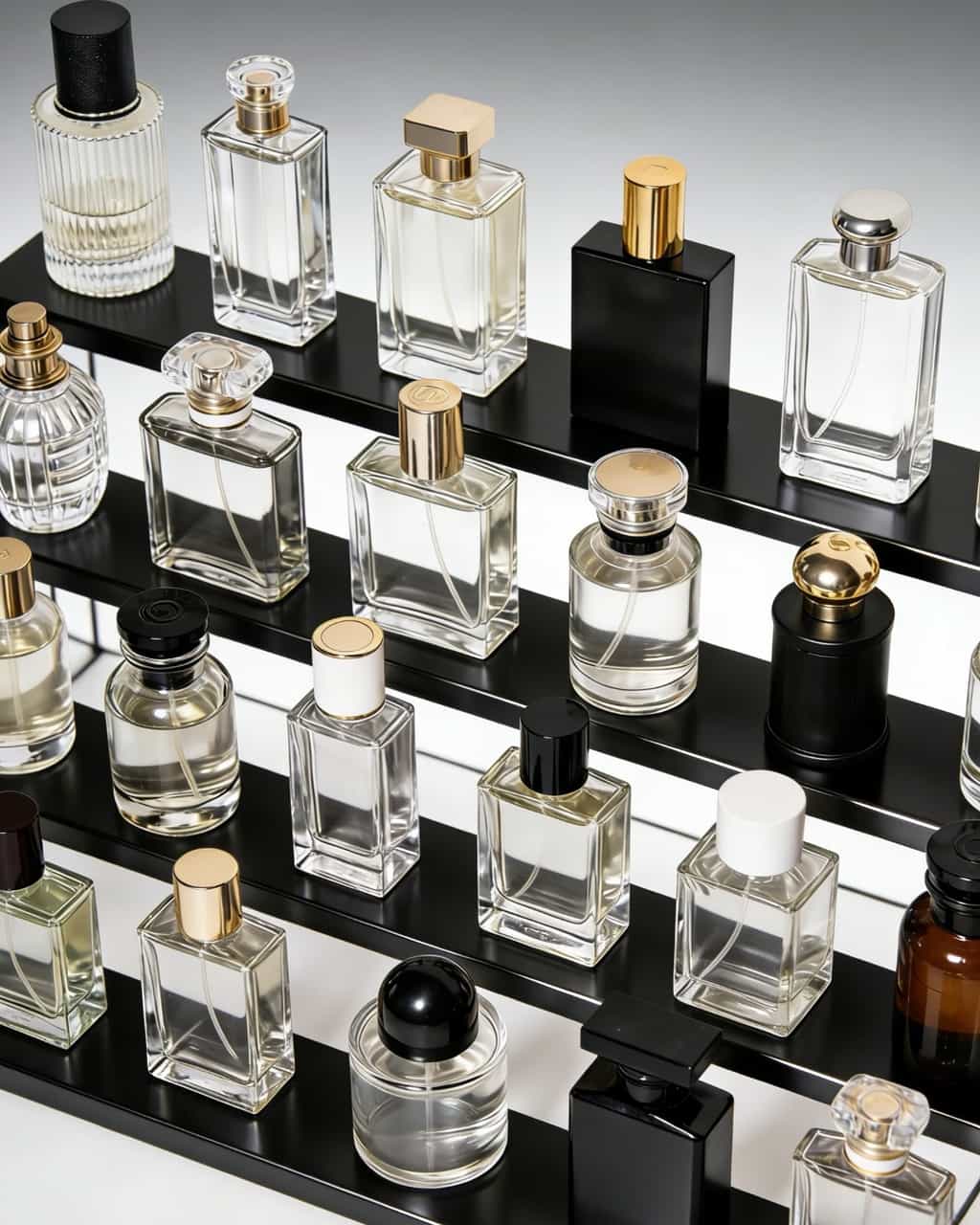
If your brand is choosing between a round apothecary-style bottle and a flat glass bottle, the practical answer is simple: use flexible label materials and stronger adhesive on cylinders, and use rigid premium decoration more freely on flat faces. Round bottles tend to create edge-lift stress on curves, while flat bottles give more stable application and a larger visual panel for premium metallic effects. That is why many buyers specify Vinyl Sticker for curved applications and reserve Metal Plate for broad, flat bottle panels.
Need pricing for perfume bottle labels, cap badges, or premium decoration?
Send us your bottle shape, size, and artwork for a fast factory-direct comparison.
Flat bottles are easier to label, but cylinders need more engineering. What is the real difference in cylinder vs flat perfume bottle labels?
From a production view, the difference is not visual style. It is mechanical behavior during application and after curing. Flat perfume bottles usually keep rejection rates below 2%, while cylindrical bottles can reach 15% rejection when the wrong material, adhesive, or label width is used. That gap matters for perfume brands ordering 1,000 to 10,000 units, because waste directly raises cost per usable bottle.
There are only 2 bottle shapes in this comparison, but the operational impact is large. Flat bottles offer a stable contact plane, so pressure distributes evenly across the label. Cylinders force the label to bend continuously around the radius. This creates tension at the edges, especially on glass bottles under 30mm diameter. In those cases, overlap compensation and material memory can increase waste by another 10%.
For buyers in cosmetics, fragrance, and premium personal care, this means the bottle should be selected together with the decoration method. A bottle that looks simple in CAD can become costly in filling and labeling if the decoration is not matched to the geometry.
| Feature | Cylinder Perfume Bottles | Flat Perfume Bottles |
|---|---|---|
| Typical rejection rate | Up to 15% with wrinkling risk | Usually below 2% |
| Labeling service cost | $0.021 - $0.025 per piece | $0.014 per piece |
| Calibration/setup | Often needs $70 one-time machine calibration | Minimal adjustment |
| Lead time impact | Often +3 days for testing and adjustment | Standard timing |
| Best material direction | Flexible film with strong adhesive | Paper, film, or rigid premium badge |
| Premium decoration suitability | Smaller, lighter, more flexible formats | Excellent for larger reflective decoration |
Curved bottles fail mainly because stress builds at the label edges. Why do curved glass bottle stickers wrinkle or peel?
The most common failure pattern on round perfume bottles is edge lifting followed by small air channels or a center wrinkle. This happens because the label face stock wants to return to its original flat state after application. On a cylinder, that recovery force pushes against the adhesive bond. The tighter the radius, the stronger the stress rebound.
A simple way to evaluate risk is to calculate bottle curvature from circumference. The basic formula is: radius = circumference / 2π. If a bottle circumference is 94.2mm, the radius is about 15mm. That is already a tight surface for many decorative labels, especially if the label height is large or the film is too stiff. On bottles below 30mm diameter, waste can increase by 10% because the label must compensate more aggressively for curvature.
For curved glass bottle stickers, adhesive coat weight and film flexibility matter more than face appearance alone. A thick, rigid, highly metallic construction may look premium in a sample book but can fail after 24 to 72 hours on a curved bottle if it stores too much memory. This is one reason procurement teams test not only print quality but also post-application recovery after transport and temperature changes.
Real-world scenario: an indie fragrance brand using 50ml cylindrical apothecary bottles wanted a large front label with metallic accents. The bottle diameter was 28mm. The first supplier used a stiffer stock, and edge lift appeared in cartons after one week. The corrective action was to reduce label width, switch to a more flexible construction, and strengthen the adhesive. Scrap dropped from double digits to a low single-digit range.
How bottle diameter changes risk
As a rule, risk increases when diameter decreases and label area increases. A 45mm diameter bottle with a 30mm wide label is much safer than a 28mm diameter bottle with the same label width. The second bottle asks the material to bend more sharply, while also increasing stress on both vertical edges.
Why label peeling on curved surface happens after packing, not just on the machine
Label peeling on curved surface is often delayed. Bottles may leave the line looking acceptable, then fail later because carton pressure, temperature changes, or glass condensation weaken the edge bond. This is why a good factory checks 24-hour and 48-hour hold, not just immediate appearance.
Flexible vinyl wins on curves, while metal decoration works best on flat faces. What materials work best for labeling round fragrance bottles?
For most buyers, the practical material decision is simple. Cylindrical bottles usually need a flexible film label with stronger adhesive. Flat bottles can use a wider range of constructions, including textured papers, premium films, and rigid decorative badges. This is where product selection should follow bottle geometry, not just artwork style.
Round bottles easily create stress rebound that leads to edge lift. A good fix is a Vinyl Sticker with strong specialty adhesive designed for curved applications. Flat perfume bottles, by contrast, are highly suitable for large-area presentation of a Metal Plate, where the reflective premium effect is easier to show cleanly on a stable, broad face. This selection logic is used widely in perfume and cosmetics packaging because it balances luxury appearance with production reliability.
For buyers asking about labeling round fragrance bottles, film flexibility often matters more than surface decoration. In Europe, demand for ultra-thin flexible PE has reportedly increased by 30% as converters try to reduce edge-lift problems on curves. For short-run launches, many brands also test UV DTF Sticker for special effects, but pure curved-surface performance still needs validation bottle by bottle.
| Material / Decoration | Best Use | Cylinder Bottle Fit | Flat Bottle Fit | Key Note |
|---|---|---|---|---|
| Vinyl Sticker | Flexible branding label | High | High | Strong option for curved surfaces when edge lift is a risk |
| Textured paper label | Classic premium look | Medium to low | High | Can wrinkle on tighter radii |
| UV DTF Sticker | Raised visual effect | Medium | High | Needs test for curve depth and panel size |
| Metal Plate | Luxury reflective branding | Low to medium | Very high | Best on broad, stable flat faces |
Cylinders cost more per usable unit, not just per printed label. How much do cylinder vs flat perfume bottle labels cost?
Buyers often compare only raw label price, but total cost should include application, waste, setup, sampling, and delay. Based on factory-side data, PP/PVC self-adhesive material costs about $0.01 to $0.02 per piece, while embossed specialty paper is about $0.03 to $0.05 per piece. UV finishing adds about $0.007 per piece. Those numbers are low by themselves. The shape-driven cost difference appears during application.
Flat surface labeling service runs around $0.014 per piece, while cylindrical surface labeling is about $0.021 to $0.025 per piece. That is roughly a 50% premium. Below 1,000 pieces, automatic application is usually not cost-effective; manual labeling can rise to $0.035 per piece. For cylinders, there may also be a one-time machine calibration fee of about $70, plus extra waste allowance if the radius is tight.
WowSticker pricing data also gives a useful baseline: a 50x30mm Vinyl Label at 1,000 pieces is about $18.29 total, while a 50x30mm UV DTF Sticker at 1,000 pieces is about $48.30 total. On paper, those look manageable. But if a cylindrical bottle drives a 15% scrap rate, your cost per usable decorated unit rises much faster than the print invoice suggests.
| Product | MOQ | Unit Price (USD) | Lead Time | Notes |
|---|---|---|---|---|
| PP/PVC self-adhesive label material | 1,000 pcs | $0.01 - $0.02 | 5 - 7 days print | Base material only |
| Embossed specialty paper label | 1,000 pcs | $0.03 - $0.05 | 5 - 7 days print | Higher visual premium, lower curve tolerance |
| UV finishing add-on | 1,000 pcs | $0.007 | Added within print cycle | Extra coating cost only |
| Flat bottle labeling service | 1,000 pcs | $0.014 | 3 - 5 days application | Stable machine speed |
| Cylinder bottle labeling service | 1,000 pcs | $0.021 - $0.025 | 3 - 5 days application | Slower speed and more setup |
| Manual labeling small batch | Below 1,000 pcs | $0.035 | Varies | Used when auto-labeling is not efficient |
| Vinyl Label 50x30mm | 1,000 pcs | $18.29 total | Reference quote basis | WowSticker pricing engine reference |
| UV DTF Sticker 50x30mm | 1,000 pcs | $48.30 total | Reference quote basis | WowSticker pricing engine reference |
Want a side-by-side cost check for round vs flat perfume bottles?
Send your bottle diameter, label size, MOQ, and finish to compare waste risk and unit economics.
What to send for a faster quote
- Bottle shape: cylinder or flat
- Bottle diameter or front panel width
- Label size in mm
- MOQ: 500, 1,000, 5,000, or more
- Material preference: vinyl, paper, UV DTF, metal plate
- Finish: matte, gloss, embossed, metallic, UV
- Application scenario: hand-applied or automatic labeling
- Delivery country and target timeline
Lead time is usually 10-15 days, but cylinders often need extra testing. What production and QA issues should buyers expect?
Standard label printing is typically 5 to 7 days, and labeling application is another 3 to 5 days. Total production time is usually 10 to 15 days after artwork confirmation. Cylindrical bottles frequently add about 3 more days because machine calibration, pressure testing, and sample validation take longer.
Sampling also matters more on curves. A physical sample fee is about $42 and is usually refundable after final order confirmation above 1,000 pieces. That sample cost is small compared with the cost of launching a luxury fragrance with labels that wrinkle on shelf. For export projects, domestic shipping to port may add about $0.11 to $0.17 per kg, plus about $7 per pallet for palletizing. Those are not large costs, but they should be planned together with scrap allowance.
QA for cylinders should include at least four checks: alignment at application, immediate wrinkle inspection, 24-hour edge-lift observation, and packed-carton hold test. Procurement teams should also check whether the label stock is compatible with automatic machine release liner requirements. This is especially important for mid-to-large beauty groups running high-speed lines.
When MOQ changes the economics
At 500 pieces, a typical 20% surcharge applies because setup is spread over fewer units. At 1,000 pieces, automatic labeling becomes more realistic. At 5,000+ pieces, base pricing may drop by about 10%. For cylindrical bottles, this scale effect helps offset higher waste and setup cost, but only if the material choice is correct from the start.
The best choice depends on brand goals, bottle geometry, and finish expectations. Which bottle shape is better for premium perfume packaging?
Flat bottles are usually better if your priority is reliable automatic labeling, lower rejection, and a larger premium decoration area. They are especially attractive for brands using large front-facing graphics, emboss textures, or reflective badges. A flat front panel makes registration more stable and gives luxury details more room to work.
Cylinders are still a strong market choice, especially in minimalist fragrance design. Market research indicates a 22% year-over-year increase in minimalist cylindrical bottles in North American and European niche fragrance segments. But that design trend raises demand for better engineering in cylinder vs flat perfume bottle labels. Brands choosing cylinders should expect stricter material control, smaller or more flexible label formats, and more QA time.
As of 2025, the global cosmetic and perfume packaging market is estimated at about $24.5 billion, with fragrance growing at a 5.2% CAGR. That growth is bringing more SKUs and more bottle experimentation. For B2B buyers, the winning approach is not to avoid cylinders entirely. It is to match the decoration to the bottle shape. WowSticker is often discussed by buyers needing this kind of shape-to-material matching because the production issue is not print alone; it is adhesion under real line conditions.
In practical terms, use a flexible Vinyl Sticker with stronger adhesive if the bottle is round and narrow. Use a Metal Plate if the bottle face is flat and you want a larger luxury reflective effect. That combination is usually safer than forcing one decoration style across both bottle formats.
Need a sample plan before your fragrance launch date?
WhatsApp your bottle photos and dimensions to check the safest label construction within 2 hours.
Flat bottles are lower-risk; cylinders need tighter spec control. Conclusion
For most perfume brands, flat bottles are cheaper and easier to label, with lower scrap, faster setup, and broader decoration freedom. Cylindrical bottles can still perform well, but they need more careful control of radius, label size, adhesive strength, and material flexibility. If a round bottle is part of your brand identity, treat it as an engineering project, not just a design choice. That is the practical takeaway from comparing cylinder vs flat perfume bottle labels for fragrance packaging.
The safest next step is to compare bottle geometry, intended finish, and MOQ before finalizing artwork. That avoids paying for premium labels that fail after application, and it helps buyers choose the right mix of Vinyl Sticker, UV DTF, or Metal Plate based on actual surface behavior.
These are the most common buyer questions before ordering. FAQ
Which is better for a startup fragrance brand: cylinder or flat perfume bottles?
Flat bottles are usually better for a startup because they are easier to label, have lower rejection rates, and give more flexibility with paper, film, or metallic decoration. If your MOQ is only 500 to 1,000 pieces, flat bottles reduce setup risk and manual application errors. Cylinders can work, but they need stricter label testing and often create more waste.
Which is better for luxury reflective branding: flat bottle labels or cylinder bottle labels?
Flat bottles are usually better for luxury reflective branding because they support larger, more stable premium decoration zones. This makes them a stronger fit for metal badges or large metallic visual elements. Cylinders are better when the brand wants a clean minimalist silhouette, but reflective decoration often needs to be smaller or more flexible to avoid edge lift.
Why do labels peel or wrinkle on round perfume bottles?
Round bottles create constant bending stress in the label. The tighter the radius, the more the label material tries to spring back to flat. That stress pushes against the adhesive and often causes edge lifting, small tunnels, or wrinkles. The risk increases on bottles under 30mm diameter, with oversized labels, stiff face stocks, or poor adhesive matching.
What is the best sticker material for labeling round fragrance bottles?
In many cases, a flexible Vinyl Sticker with stronger adhesive is the safest option for round fragrance bottles. It conforms better to curved glass and helps reduce rebound stress at the edges. Paper labels can work on larger radii, but on tighter cylinders they are more likely to wrinkle. Always test the exact bottle diameter and label dimensions before bulk production.
Are flat perfume bottles cheaper to label than cylinder bottles?
Yes. Factory-side data shows flat surface labeling at about $0.014 per piece, while cylindrical labeling is about $0.021 to $0.025 per piece. Cylinders may also require a one-time setup fee of about $70 and can create up to 15% rejection if the construction is wrong. That means the total cost difference is often larger than the print price alone.
How do I calculate the curvature of a glass bottle for label printing?
Use the simple formula: radius = circumference / 2π. Measure the bottle circumference in millimeters, then divide by approximately 6.283. For example, a 94.2mm circumference gives a radius of about 15mm. Smaller radius means tighter curvature and higher label stress, so this number helps determine whether you need a more flexible material or smaller label footprint.
What should I send before asking for a quote?
Send bottle shape, bottle diameter or front panel size, label dimensions, MOQ, preferred material, finish, application method, delivery country, and target timing. A front and side bottle photo also helps. This information lets the supplier estimate not only print price but also setup, scrap risk, and whether a flat or curved-surface solution is more suitable.
Is a premium upgrade worth the extra cost on a cylinder bottle?
It depends on the radius and the decoration type. A premium upgrade is worth it if the material remains flexible enough for the curve and the added finish does not increase edge stress too much. On narrow cylinders, using an expensive rigid construction can actually raise total cost through scrap. In those cases, a simpler flexible film often gives better luxury results in real production.