Artwork prepress guide
Can Customer Artwork Go Straight to Print? How We Prepare AI Images, Blurry Files, Photos, and Complex Designs
Usually not. AI concepts, blurry screenshots, web images, photographs, textured objects, and flattened PDFs may all need reconstruction before production. A usable print file must match the final size and provide clean artwork, controlled colors, a dieline, and separate finishing layers where required.
When a complex design has no usable vector file, WowSticker needs extra time for cleanup, manual redrawing, color separation, and proof preparation. This normally adds 1 to 2 business days before production.
Case 1: a WowSticker customer's 2 x 5 inch perfume label
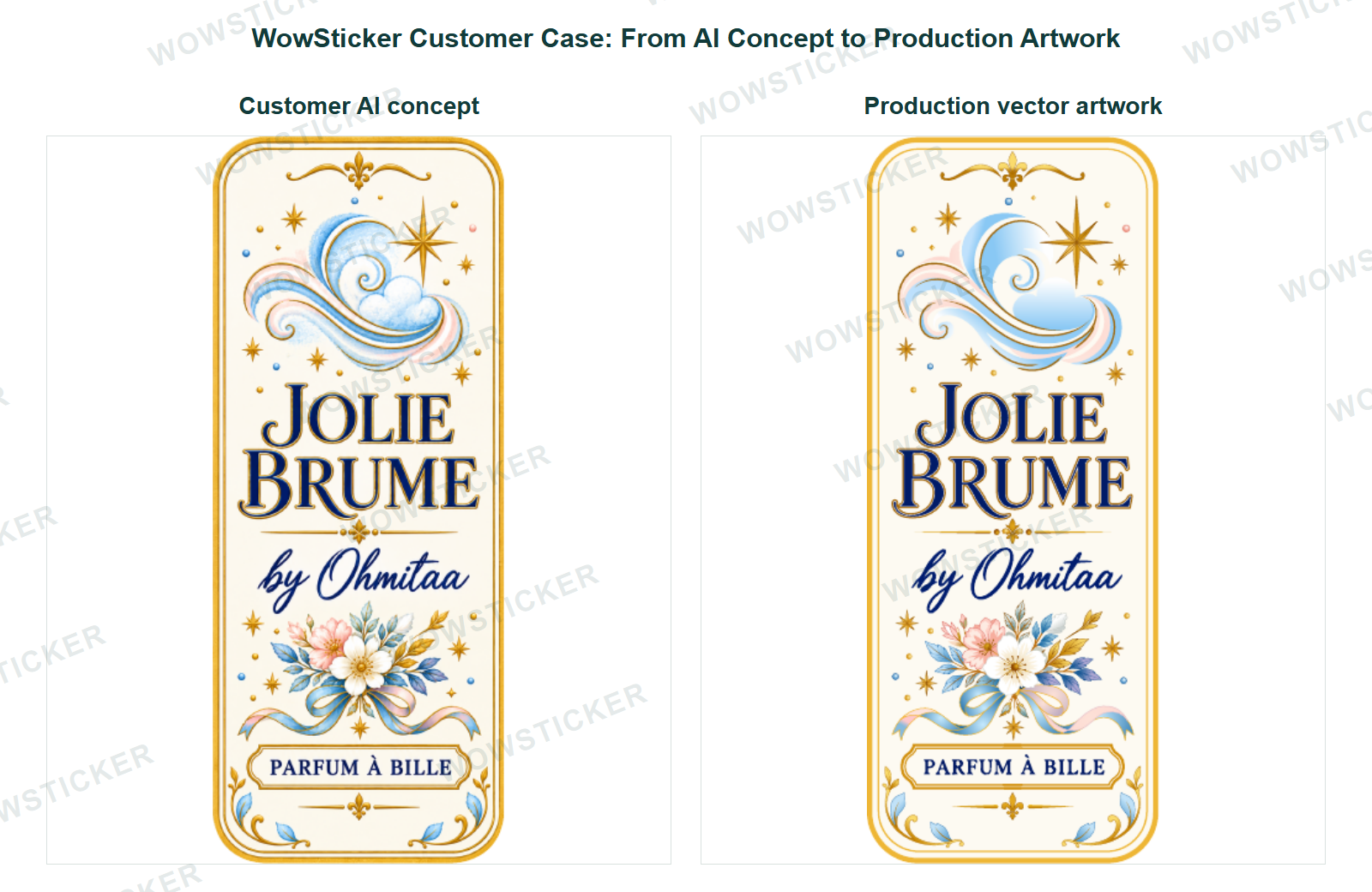
A customer supplied an AI-generated concept for a perfume label. The design used painterly texture, soft multicolor transitions, strong highlights, shadows, and simulated gold. It looked rich on screen, but the effects were fused into one raster image.
Both supplied PDFs were 2 x 5 inches. The original contained one raster image measuring 793 x 1,983 pixels, equal to about 396 ppi at the final size. Its problem was not simply resolution. The key issues were editability, color separation, and control of metallic and finishing areas.
The completed production PDF contained path-based artwork rather than an embedded raster image on the label page. This made the lettering, borders, stars, flowers, and decorative shapes scalable and easier to recolor or assign to foil, embossing, spot color, and cutting layers.
Why does the vector version look flatter?
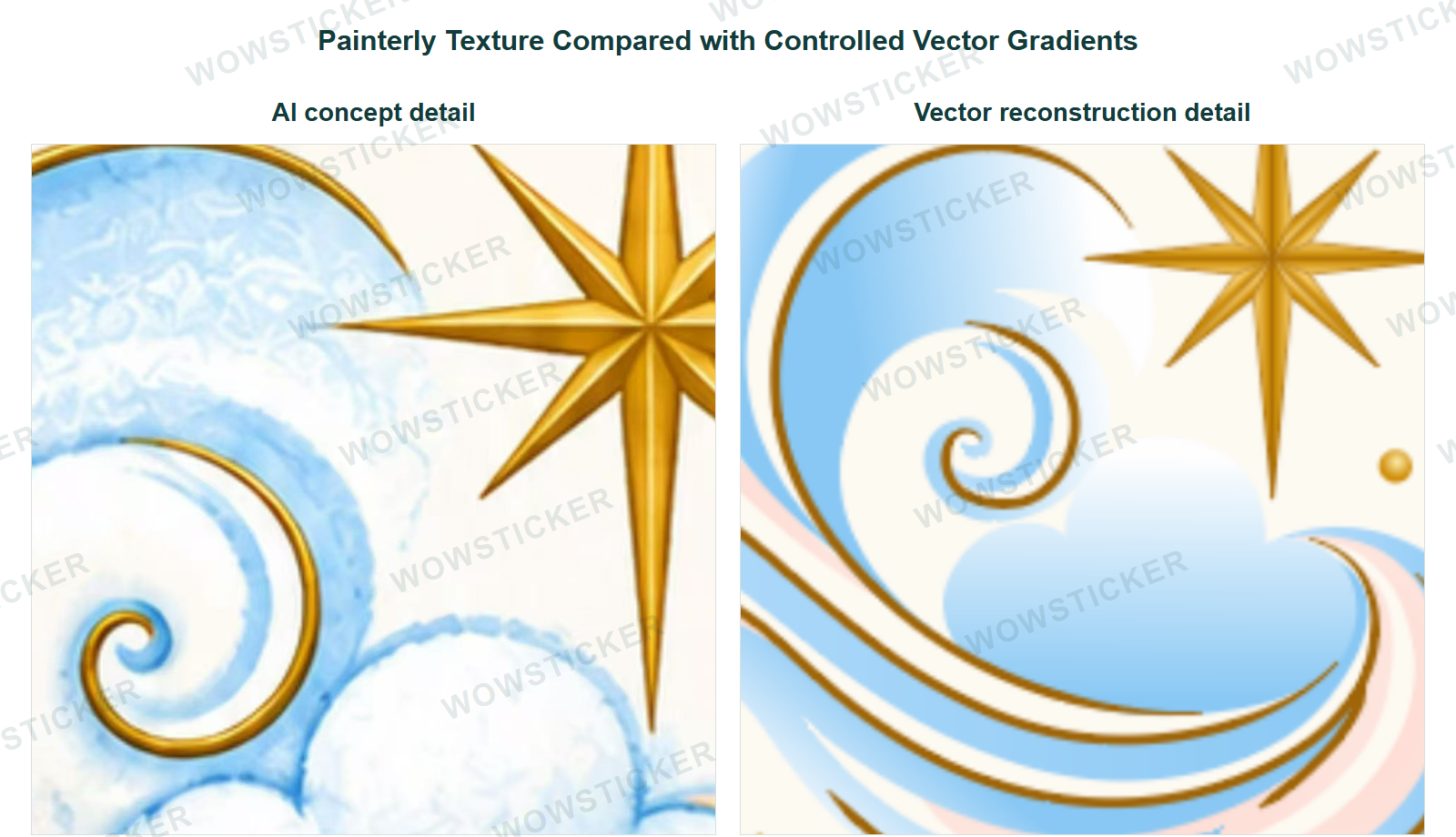
The AI concept creates depth with thousands of soft pixel transitions. Vector artwork uses controlled shapes, curves, fills, strokes, and gradients. During reconstruction, some oil-paint texture and dramatic lighting must be simplified so the file remains editable and predictable in production.
This is a deliberate tradeoff. The vector version may look less three-dimensional on a screen, but it provides cleaner edges, reliable scaling, color control, and separate finishing layers.
For this customer case, WowSticker first built the structural line drawing, compared the work with the source during production, and then completed the colored vector version. The composition and identity were retained while the uncontrolled screen effects were converted into manufacturable shapes.
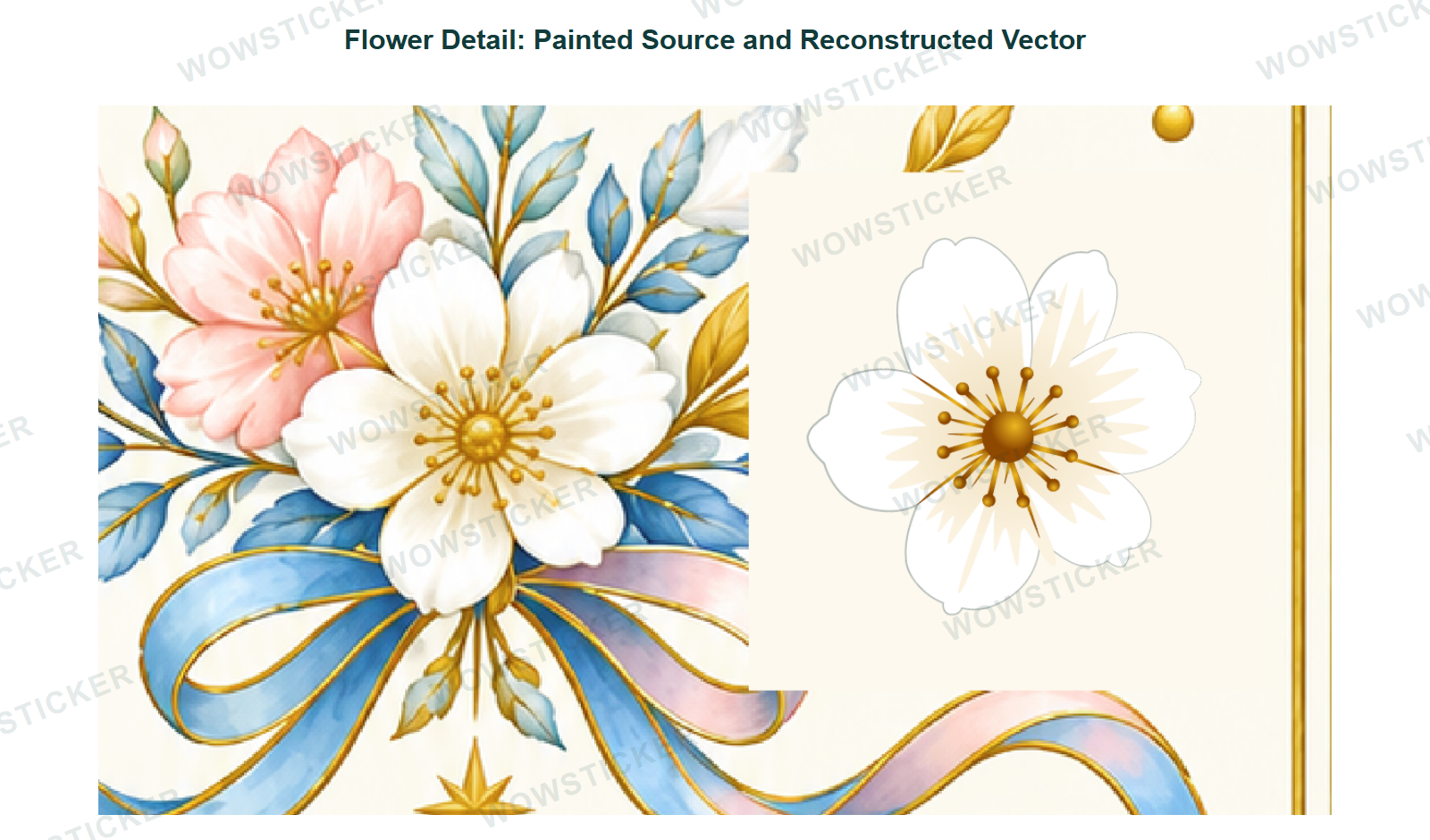
The small white flower with a gold center shows the same change at detail level: painterly petals become defined shapes, while the gold center becomes a controllable production element.
How WowSticker prepares complex artwork
1. Confirm the product and final size
We confirm the dimensions, shape, material, application surface, quantity, print method, and required finish. A paper label, clear film label, metal label, and nickel sticker require different production files.
2. Inspect the actual file
A PDF, AI, EPS, or SVG can still contain raster images, missing fonts, broken links, or flattened effects. We inspect the objects inside the file instead of trusting the extension.
3. Build the production structure
We redraw the silhouette, border, lettering, logo, ornaments, and other critical details. Automatic tracing is only a starting point when it creates rough curves or too many anchor points.
4. Separate print and finishing layers
CMYK, spot colors, white ink, foil, embossing, varnish, cut lines, and registration marks must be clearly separated. A flattened AI image does not contain these production instructions.
5. Preflight and approve the proof
We check size, bleed, safe area, image resolution, fonts, colors, line thickness, overprint, dieline alignment, and finishing layers. Production begins after proof approval.
More customer artwork examples
Case 2: a raised bottle surface becomes tooling artwork
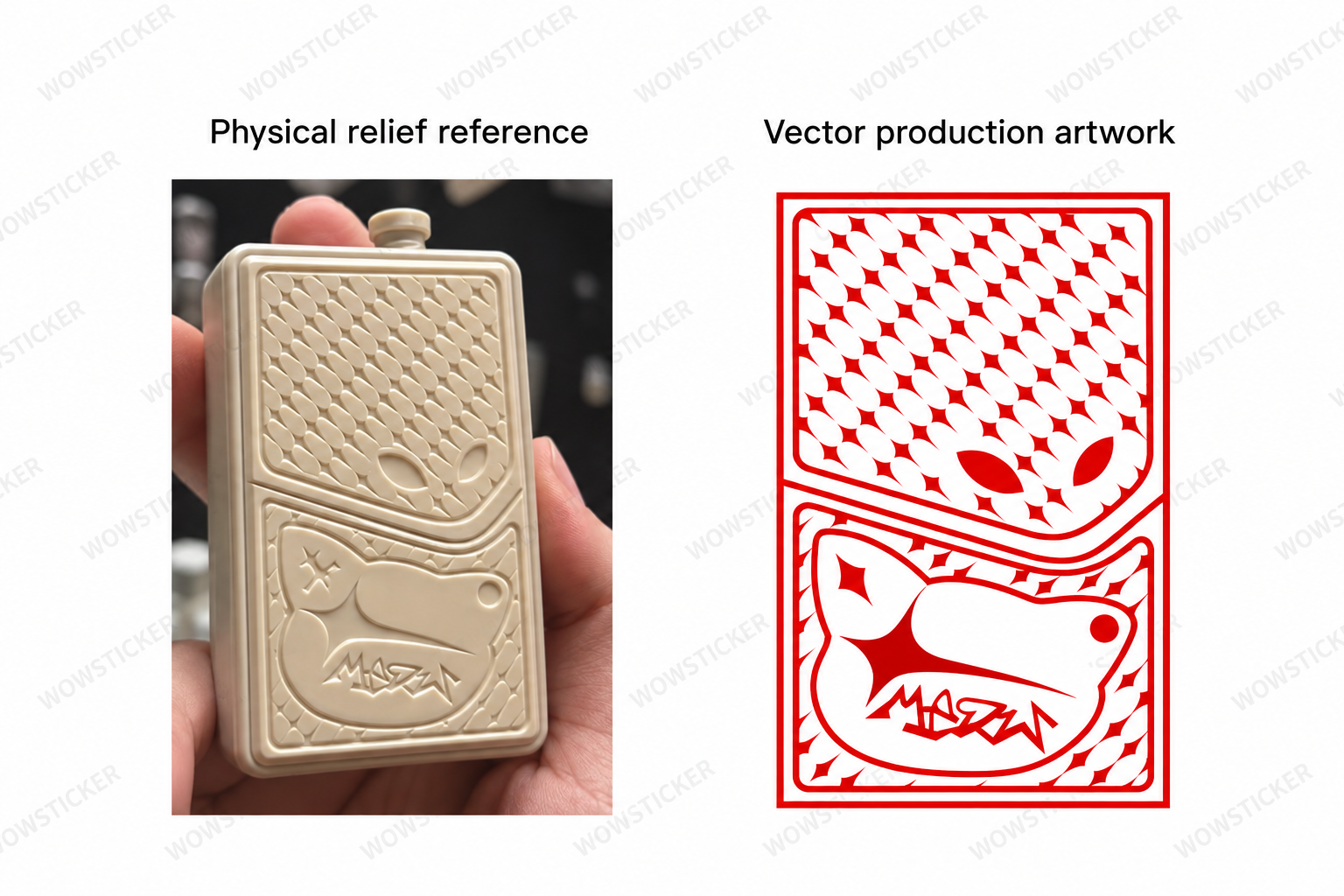
A physical ceramic bottle may have real relief that cannot be reproduced by a flat image alone. Vector artwork defines the areas for foil, embossing, debossing, or other tooling. The three-dimensional result comes from the material and process.
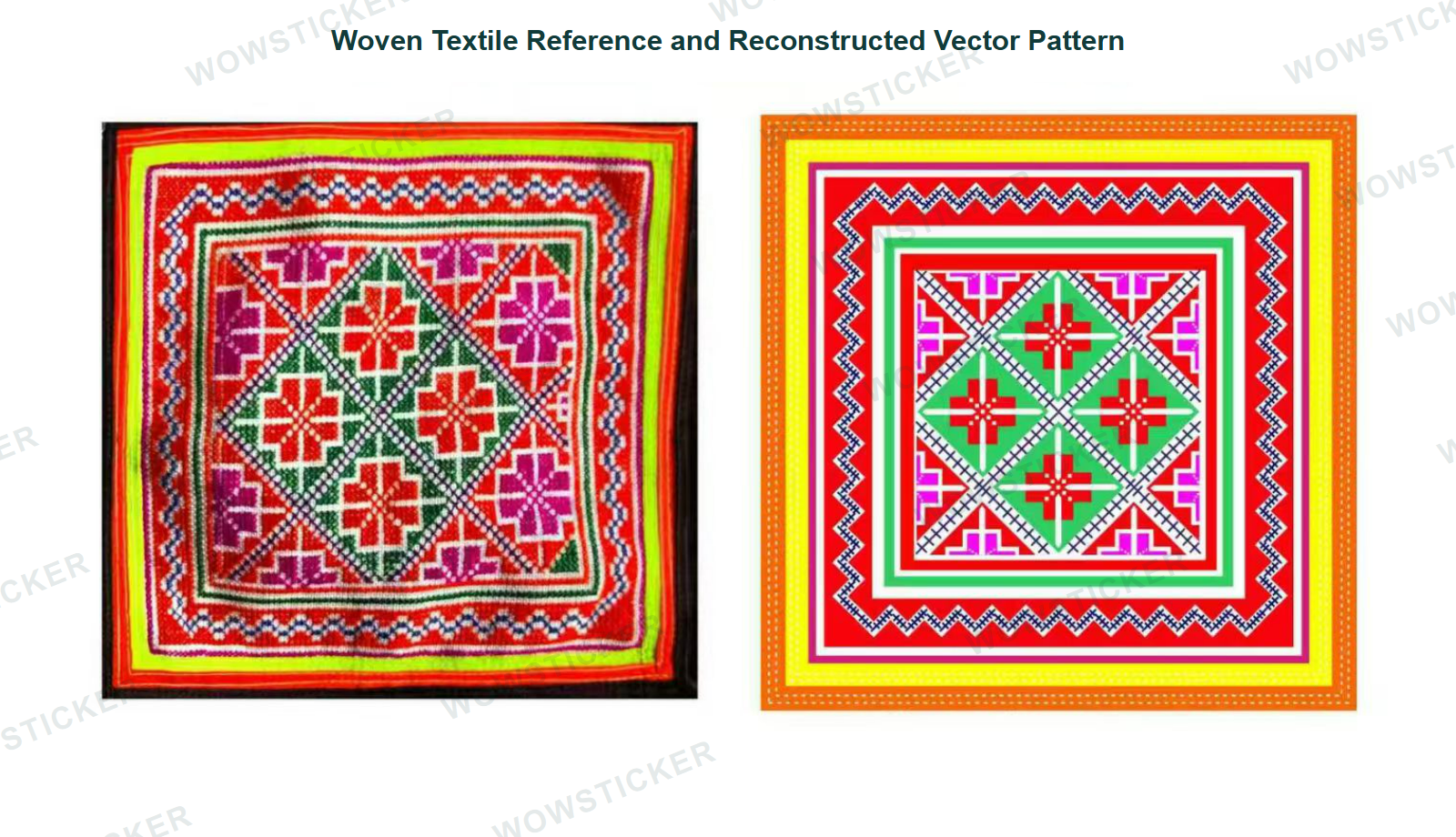
Case 3: woven fabric becomes a repeatable vector pattern
A textile photograph contains fibers, shadows, stitching, and small irregularities. We rebuild the visual structure as repeatable lines and color areas. The vector version does not copy every fiber, but it can be resized, recolored, aligned, and reproduced consistently.
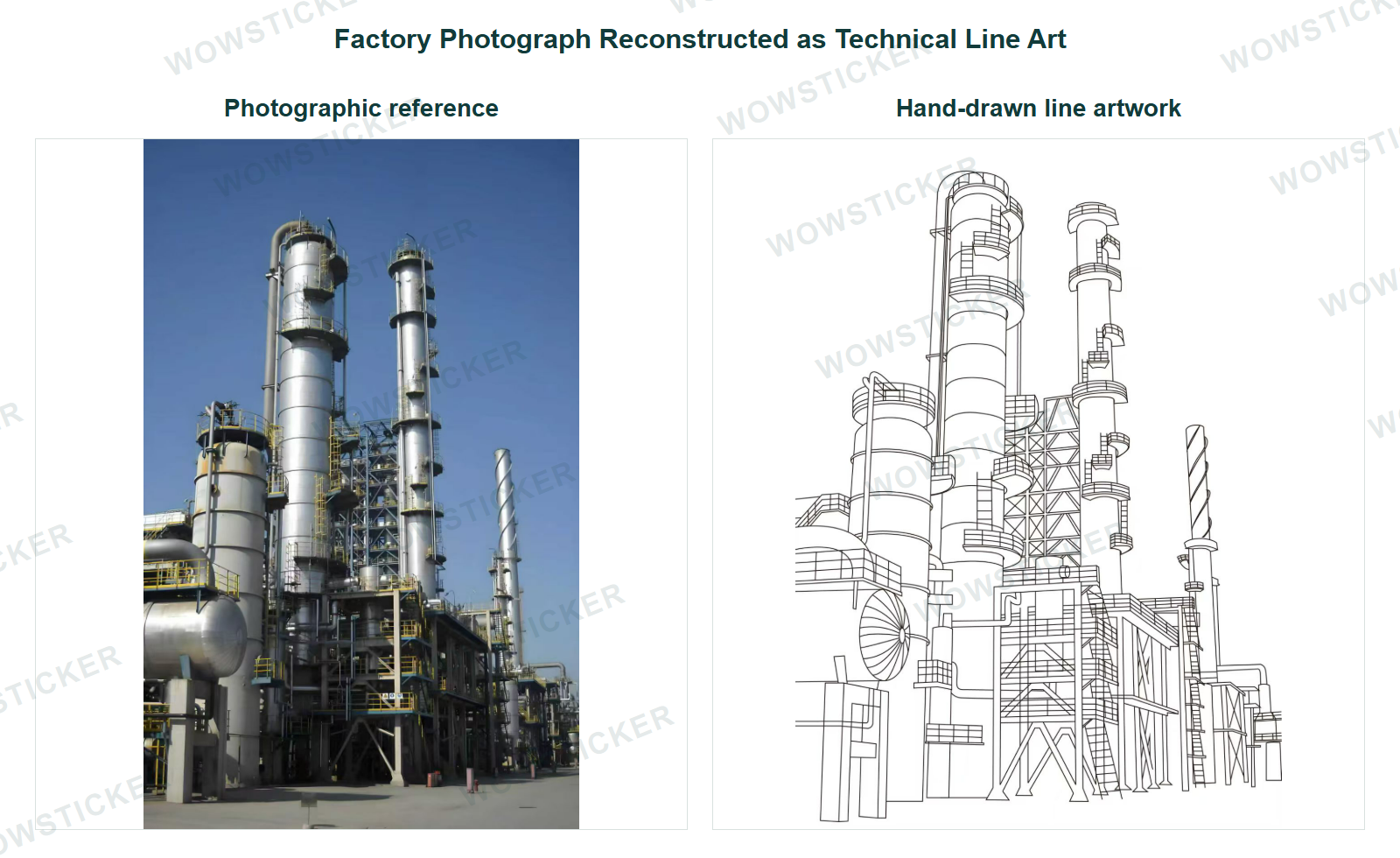
Case 4: a factory photograph becomes technical line art
A photograph contains continuous tones, reflections, and atmosphere. For this case, the towers, pipes, platforms, ladders, and structural frames were redrawn as clean line artwork. The result can be enlarged and used where a controlled technical illustration is more suitable than a photograph.
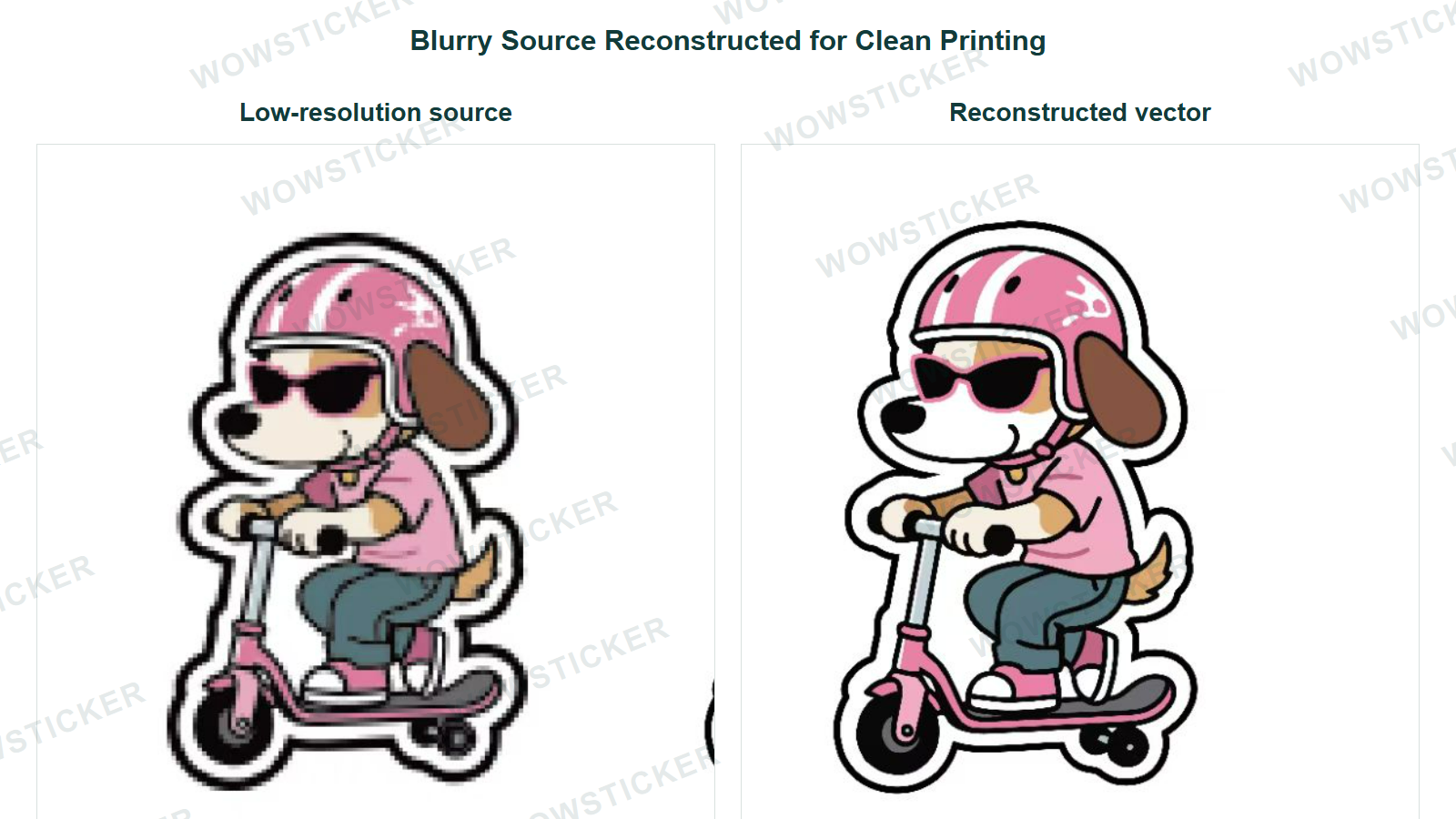
Case 5: a blurry cartoon becomes clean production artwork
Changing a resolution field from 72 dpi to 300 dpi does not restore missing edges. The blurry character required cleaner outlines, corrected shapes, and rebuilt color areas. The reconstructed version remains sharp when enlarged and gives the printer a much clearer production source.
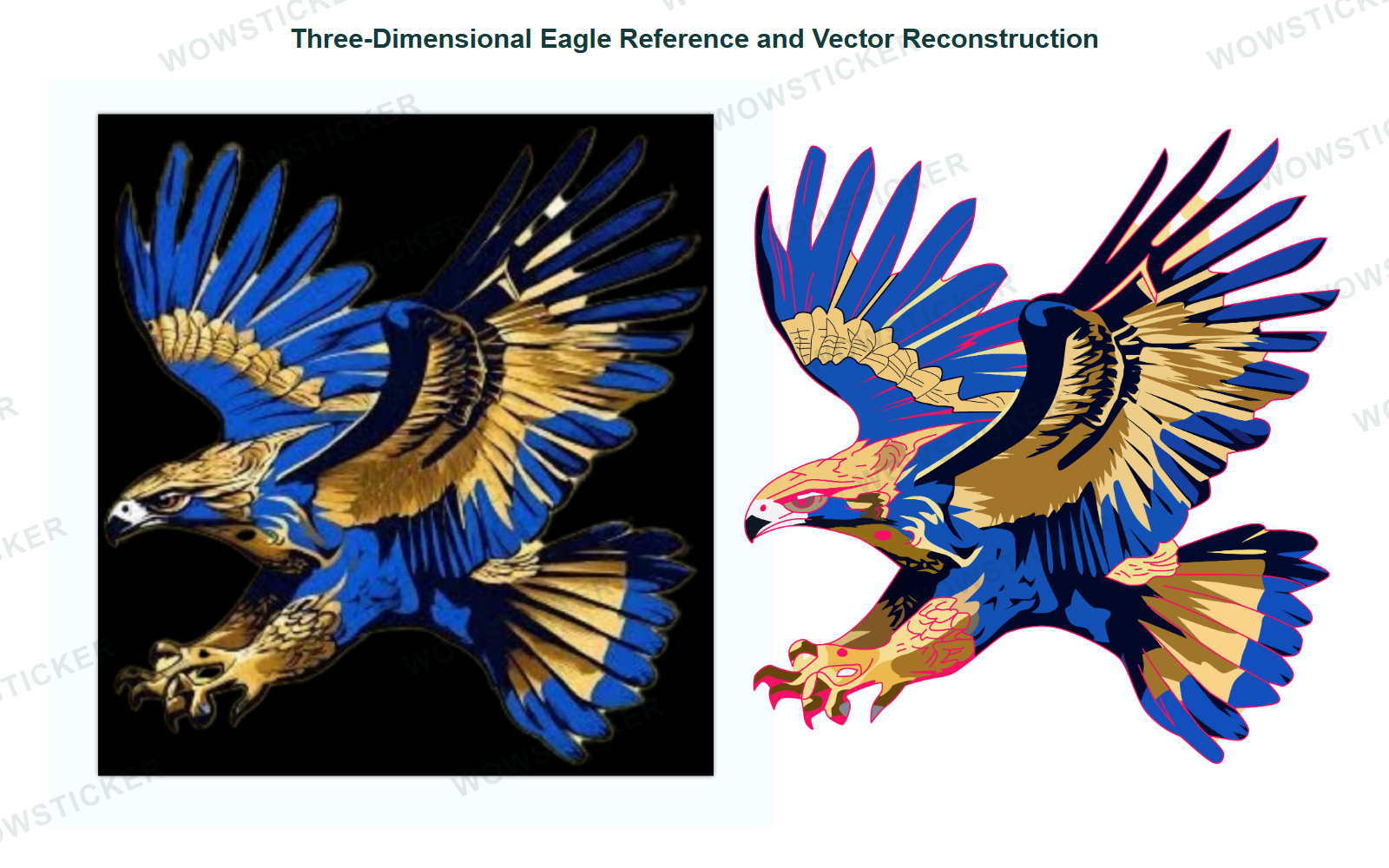
Case 6: a three-dimensional eagle becomes controlled vector shapes
The source eagle uses texture, shadows, highlights, and overlapping feathers to create depth. The vector version is flatter, but its edges stay clean when enlarged and its colors can be separated or adapted for special printing and finishing processes.
How should a real metallic effect be produced?
Gold-colored pixels are not metal. Select the process according to the physical result you need.
| Desired result | Recommended process | Artwork needed | Main limitation |
|---|---|---|---|
| True metal emblem | Metal label or nickel sticker | Clean vector silhouette and confirmed size | More tooling than ink printing |
| Bright gold or silver accent | Hot or cold foil | Solid vector layer for the foil area | Fine gaps may need simplification |
| Subtle metallic shimmer | Metallic ink | Defined spot color and material proof | Less reflective than foil |
| Raised or recessed detail | Embossing or debossing | Separate aligned vector layer | Detail depends on material and tooling |
| Metallic look with ordinary ink | CMYK gradient | Color-managed artwork and proof | Visual simulation only |
For a strong metallic appearance on perfume packaging, WowSticker normally recommends a metal label or nickel sticker. Foil is a practical option for selected gold or silver details. Ordinary CMYK ink can imitate color and light, but it cannot create a truly reflective metal surface.
Can the supplied file go directly to production?
| File received | Typical decision | Main action | Main risk |
|---|---|---|---|
| Editable vector file built to the dieline | Often, after preflight | Check paths, colors, fonts, bleed, and finish layers | Hidden raster objects or missing layers |
| High-resolution raster at final size | Sometimes for full-color print | Confirm effective resolution, color, bleed, and proof | Difficult to edit or separate for special finishes |
| Low-resolution JPEG, PNG, or screenshot | Usually no | Request the best source and redraw key elements | Pixelation and inaccurate edges |
| AI concept with complex light or metal effects | Usually needs adaptation | Rebuild key elements and choose a physical process | Screen effects may not be printable with ordinary ink |
WowSticker's recommendation
Treat an AI image as a visual brief until its production structure is verified. Send the best source file, final size, material, and the physical effect you want customers to see and touch.
Do not rely on ordinary ink to reproduce a highly reflective metal effect. Use a metal label, nickel sticker, foil, metallic ink, or embossing when the design requires real metallic or raised detail.
If painterly texture is essential, a controlled high-resolution raster layer may be retained while text, dielines, white ink, foil, and other production layers are built as vectors. The goal is not to make the vector file look more dramatic on a phone. The goal is a clean, accurate, repeatable printed result.
Complex artwork without a usable vector source normally adds 1 to 2 business days for image processing and proof preparation.
Frequently asked questions
Is every PDF a vector file?
No. A PDF may contain paths, raster images, fonts, or a mixture. Its internal objects must be inspected.
What customer files most often need reconstruction?
AI concepts, screenshots, blurry web images, photographs that must become line art, and designs for foil or embossing often need reconstruction or separate production layers.
Does changing 72 dpi to 300 dpi make a blurry image sharp?
No. Changing the number does not recreate missing detail. Important outlines, logos, and lettering may need manual reconstruction.
Why does the vector reconstruction look flatter?
It replaces soft pixel transitions with controllable paths and fills. This reduces some visual depth but improves scaling, editing, color separation, and finishing control.
What is the best option for a strong gold or silver effect?
Use a metal label or nickel sticker for a true metal appearance, or foil for selected reflective areas. CMYK printing only simulates metal with color.
Will artwork reconstruction affect delivery time?
Yes. Complex artwork without a usable vector file normally adds 1 to 2 business days before production.