wowsti copyright notice: This article is prepared for WowSticker packaging and label buyers. Reproduction, quotation, excerpting, or commercial reuse requires prior permission from wowsti.
Yes—if your fragrance bottle has unusual curves, tapered shoulders, recessed panels, or a very small front-facing area, custom die cut perfume labels often perform better than standard rectangles. But they are not automatically the best choice for every SKU. The right decision depends on four practical factors: the usable label zone, how visible the edges will be, the material you plan to use, and whether your bottle decoration needs to look “built in” or simply clean and efficient. For many brands, a rectangular label is still the lowest-risk option for fast launches. For others, shaped stickers for fragrance bottles create a much better visual fit and reduce the “sticker pasted on top” look.
If you are comparing options now, start with this rule: choose rectangles when the bottle face is flat, centered, and generous; choose die-cut labels when the bottle silhouette or artwork needs a shape match; consider UV DTF Sticker when you want a more seamless decorative effect without a visible background edge. If you send WowSticker your bottle photo, target size, quantity, material preference, delivery country, and artwork file, we can help you assess which route is more practical before sampling.
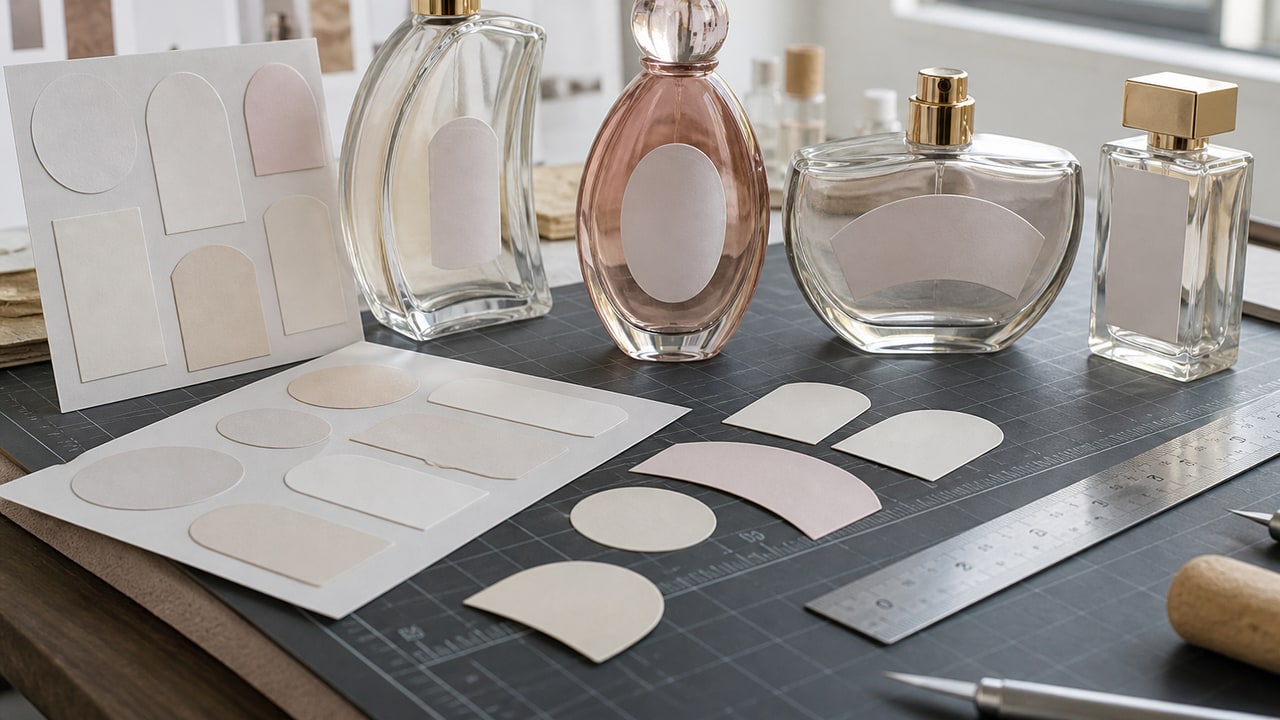
What is the real difference between custom die-cut labels and standard rectangles?
The short answer: rectangles optimize simplicity, while die-cut labels optimize fit and presentation. A standard rectangle is easy to proof, print, align, and apply. A custom die-cut label is cut to a specific contour so the outer shape follows your bottle panel, logo frame, illustration silhouette, or decorative concept.
On a conventional bottle with a flat front panel, a rectangle usually looks clean and costs less to manage operationally. On a bottle with rounded shoulders, narrow waistlines, asymmetric fronts, or unusual glass geometry, a rectangle may leave awkward empty corners, wrinkle near edges, or visually fight the bottle design. In those cases, precision cut cosmetic labels can look more intentional and premium.
This is why bottle shape matters more than many first-time buyers expect. The label is not just a printed element. It is part of the front-facing architecture of the package. When the bottle is highly designed, a generic label shape can reduce the effect of the whole presentation.
When should you choose custom die cut perfume labels for a unique bottle?
Choose die-cut labels when the bottle shape creates visible mismatch with straight edges. If the bottle has curved shoulders, an arched front panel, a medallion-like label area, or a small central decoration zone, die-cutting often gives a better result.
Common triggers include:
- Non-standard front panel shape such as oval, shield, arch, wave, or tapered geometry
- Very limited label area where every millimeter affects balance
- Premium branding goals where edge shape is part of the visual identity
- Decorative contour artwork that loses impact inside a rectangle
- Curved bottle faces where corners of a rectangle are more noticeable
For perfume founders, the biggest advantage is often visual integration. A die-cut label can feel designed for the bottle rather than merely attached to it. For procurement teams, the value is not only aesthetic. A better-fitting shape may reduce edge lifting risk in some applications because the label avoids unnecessary corners extending into unstable areas.
Need a quick fit check? Send WowSticker your bottle photo, approximate front label area, target quantity, material preference, and artwork file. We can suggest whether vinyl die-cut labels or UV DTF decoration is the more suitable direction.
When is a standard rectangular label still the smarter choice?
A rectangular label is still the smarter choice when your priority is speed, simplicity, broad compatibility, or lower execution risk. If the front panel is flat and your branding system is typography-led, a rectangle may deliver everything you need with fewer variables.
Rectangles remain strong when:
- The bottle front is flat and symmetrical
- Your artwork is horizontal or block-based
- You need easier visual alignment during application
- You want simpler reorders across multiple SKUs
- You are launching a test batch before investing in refined decoration
Many fragrance brands also deliberately choose rectangles because they signal clarity and modernity. So the question is not whether rectangles are basic. It is whether they suit the bottle and brand language. If the bottle itself carries the uniqueness, a rectangle can create useful contrast.
Which label shape works better on curved, tapered, or irregular perfume bottles?
For strongly curved or irregular bottles, shape-matched labels usually work better. But “better” does not always mean more complex. Sometimes a softened rectangle with rounded corners is enough. In other cases, a fully customized contour is the only shape that looks natural.
Here are two common pain points with unique bottles:
1. The bottle looks premium, but the rectangle looks pasted on
This happens when the bottle silhouette is expressive but the label shape ignores it. The result is visual conflict: elegant bottle, generic label. A custom contour can restore harmony.
2. The label corners sit too close to curves or edges
On narrow or tapered faces, rectangle corners can sit in unstable areas. This increases visibility of misalignment and may make edge behavior less forgiving, depending on material and surface conditions. A die-cut shape can pull the outer edge inward and use the stable central zone more efficiently.
If your bottle has a flat micro-panel surrounded by curves, ask for a technical fit review before finalizing. A contour that looks beautiful on screen may still need adjustment for real application tolerance.
Custom die-cut labels vs standard rectangles: which is better for perfume procurement?
| Decision Factor | Custom Die-Cut Labels | Standard Rectangles |
|---|---|---|
| Visual fit on unique bottles | Usually better on non-standard bottle faces | Best on flat, regular, centered panels |
| Artwork flexibility | Good for contour-based logos and decorative shapes | Good for text-heavy or systemized artwork |
| Application tolerance | Can be good, but alignment may require tighter control | Usually easier to align visually |
| Sampling value | High when bottle shape is a key brand asset | High for rapid first-round testing |
| Design impact | Stronger premium or integrated feel | Cleaner, simpler, more universal feel |
| Multi-SKU consistency | May require separate contours by bottle variant | Easier to standardize across line extensions |
| Use with Vinyl Sticker | Very suitable for shaped front labels | Very suitable for standard front labels |
| Use with UV DTF Sticker | Useful when you want decoration without a classic label look | Less relevant if a printed borderless effect is preferred |
Does die-cutting always mean higher cost?
No. It often means a different cost structure, not automatically a much higher total cost. Traditional physical dies and digital die-cutting work differently, and that changes how custom shapes are evaluated.
For small to mid-volume branded packaging projects, digital cutting can reduce the barrier to trying shaped labels because it may avoid the need for a conventional physical cutting tool in some workflows. That makes custom contours more accessible during prototyping, sampling, artwork iteration, and shorter production runs. However, final cost still depends on size, quantity, material, finish, printing method, tolerance, and order details.
If you are comparing quotes, do not ask only, “What is the unit price?” Ask:
- Is cutting handled digitally or with a physical die?
- Will shape complexity affect waste or setup?
- Does the material need lamination or special surface finishing?
- Will the same contour be reused across repeat orders?
- How many proofing rounds are expected before approval?
Budget Estimator Disclaimer: Any cost, MOQ, or lead time discussion in this article is for planning logic only, not a formal quote. Actual pricing and minimums depend on material, size, quantity, finishing, artwork complexity, production method, and delivery details.
How do vinyl stickers and UV DTF stickers compare for unusual perfume bottles?
For most fragrance projects in this category, the real comparison is not just die-cut versus rectangle. It is also Vinyl Sticker versus UV DTF Sticker.
Vinyl Sticker
Vinyl is the more familiar label route. It works well when you want a defined label piece with printed artwork, controlled shape, and material options such as matte, gloss, clear, metallic-look, or textured effects depending on project direction. Die-cut vinyl is often the first recommendation when the goal is a shaped front label.
UV DTF Sticker
UV DTF is often better when you want a transfer-style decoration that looks less like a conventional label and more like an applied graphic element. On some unusual bottles, this can create a cleaner result because there is no obvious background panel around the artwork. It can be especially useful for logos, icons, fine decorative details, and bottle shapes where a standard label edge would feel intrusive.
In simple terms:
- Choose Vinyl Sticker if you want a clear label piece with shape-defined edges.
- Choose UV DTF Sticker if you want a more borderless decorative appearance.
The final choice depends on your bottle surface, decoration size, target look, and application workflow. Testing on the actual bottle is strongly recommended before scale-up.
Not sure whether to use vinyl or UV DTF? Send WowSticker the bottle material, front view photo, decoration size, artwork layers, and order country. We can help you compare visual effect and production suitability before you place a full order.
What design rules matter most for non-standard label dimensions?
The shorter answer: shape should follow the usable panel, not just the artwork file. Many label issues happen because the design is approved in 2D before anyone checks how it behaves on the real bottle.
Key rules for non standard label dimensions include:
- Map the true front-facing area rather than measuring only the widest point
- Keep safe margins away from aggressive curves, embossed edges, and bottle transitions
- Reduce sharp outward points unless they are essential to the design
- Test readability at final applied distance on the bottle, not only on screen
- Align shape logic with brand hierarchy so the contour supports, rather than competes with, the logo
A custom shape should solve a packaging problem or improve brand impact. If the contour is too decorative for the available surface, it can make placement and repeatability harder without adding much value.
What are the biggest risks when buying shaped stickers for fragrance bottles?
The main risks are over-design, under-testing, and unclear application expectations. A beautiful shape can fail in production if it ignores tolerance, curvature, or handling reality.
| Risk | Why It Happens | How to Reduce It |
|---|---|---|
| Edge lifting concern | Label extends into unstable curved zones or corners are too exposed | Shorten outer contour and keep critical edges inside stable areas |
| Misalignment visibility | Shape is asymmetrical or bottle lacks strong alignment references | Build clear positioning marks into proofing and test real application |
| Artwork feels crowded | Decorative shape reduces usable print area | Prioritize hierarchy and simplify copy |
| Sampling delays | Too many shape revisions after visual approval | Confirm bottle template and panel size before final artwork |
| Wrong material choice | Surface behavior and desired finish were not matched early | Review bottle material, finish, and label effect together |
How should founders and buyers compare options before ordering?
Use a decision framework instead of choosing by appearance alone. Start with the bottle, then the decoration goal, then the production route.
| If your priority is... | Usually start with... | Why |
|---|---|---|
| Fast market testing | Standard rectangular vinyl label | Simple, clear, and easier to revise |
| Premium fit on an unusual bottle | Custom die-cut vinyl label | Improves shape harmony and front-view integration |
| Minimal visible label edge | UV DTF sticker | Can create a more decoration-led appearance |
| Multi-SKU operational consistency | Rectangular system or softened-corner standard shape | Easier to align across a product line |
| Small front panel with decorative geometry | Precision die-cut shape | Uses limited space more intentionally |
What should you ask a supplier before sampling?
Before you request production, ask questions that reveal suitability, not just price. This is especially important for precision cut cosmetic labels on perfume bottles because appearance and tolerance are closely linked.
- Can you review my bottle photo or template before confirming the shape?
- Is digital die-cutting available for this project?
- Which material is more suitable for this bottle surface: vinyl or UV DTF?
- How should I prepare the cut line and safe area in the artwork?
- Will a sample be based on the actual bottle curvature or only flat artwork?
- What file format is preferred for contour cutting?
- Are there finishing options that may affect edge appearance?
- How should I evaluate application tolerance on the real bottle?
Budget Estimator Disclaimer: MOQ, sample logic, production timing, and unit economics vary by material, size, quantity, finishing, and shipping destination. Treat early discussions as planning guidance until a final specification is confirmed.
Inquiry checklist for custom die cut perfume labels
To get a useful recommendation faster, send this information in your first inquiry:
- Bottle photos from front and side
- Usable label area or bottle drawing if available
- Bottle size, such as 50ml or other volume
- Preferred label width and height, or “please advise”
- Target quantity
- Material preference: vinyl sticker or UV DTF sticker
- Surface look: matte, gloss, clear, metallic-look, or other preferred effect
- Application method: hand application or factory line if applicable
- Delivery country
- Artwork file in AI, PDF, or vector format if available
- Any required contour style, such as oval, arch, crest, wave, or custom outline
Ready to compare options? Send WowSticker your size, quantity, material choice, bottle shape, delivery country, and design file. We can help you judge whether a rectangle, die-cut vinyl label, or UV DTF transfer is the more practical choice for your fragrance packaging.
Final recommendation: which option should most perfume brands choose?
Most perfume brands should not start by asking which label shape is “better” in general. They should ask which shape best fits the bottle, the brand language, and the launch stage.
Choose a standard rectangle when you want operational simplicity, clean structure, and low-friction testing. Choose custom die cut perfume labels when the bottle shape is distinctive enough that a generic rectangle weakens the visual result. Choose UV DTF Sticker when you want the decoration to feel more integrated and less like a traditional label panel.
For unusual fragrance bottles, shape-fit matters more than many buyers expect. A small adjustment to the outer contour can make the entire package look more expensive, more deliberate, and more brand-ready. The key is to validate the bottle geometry early and sample before scaling.
Frequently asked questions
Are custom die cut perfume labels always more expensive than rectangles?
Not always. The cost difference depends on quantity, size, material, finishing, and whether the cutting workflow is digital or tool-based. In many projects, shaped labels are evaluated as a planning option rather than an automatically premium-only choice.
Do shaped stickers work better on curved fragrance bottles?
Often yes, especially when a rectangle would push corners into unstable or visually awkward areas. But the exact contour still needs to match the true usable panel on the bottle.
What is better for a unique bottle: vinyl sticker or UV DTF sticker?
Vinyl is usually better when you want a defined label piece with a clear outer shape. UV DTF is often better when you want a more decoration-like effect with less visible label background.
Can I use one label shape across multiple perfume bottle variants?
Sometimes, but not always. If bottle fronts vary meaningfully, one contour may not fit all SKUs well. Rectangular systems are generally easier to standardize across a line.
What files should I prepare for a die-cut label inquiry?
Ideally send vector artwork, bottle photos, target size, quantity, and any preferred contour direction. If you do not have a final cut line yet, a supplier can often review the bottle shape first and advise on the outline.
Is sampling necessary for non-standard label dimensions?
Yes, strongly recommended. Unique bottles create more fit and alignment variables than flat standard packaging. A sample helps confirm appearance and application behavior before larger production.