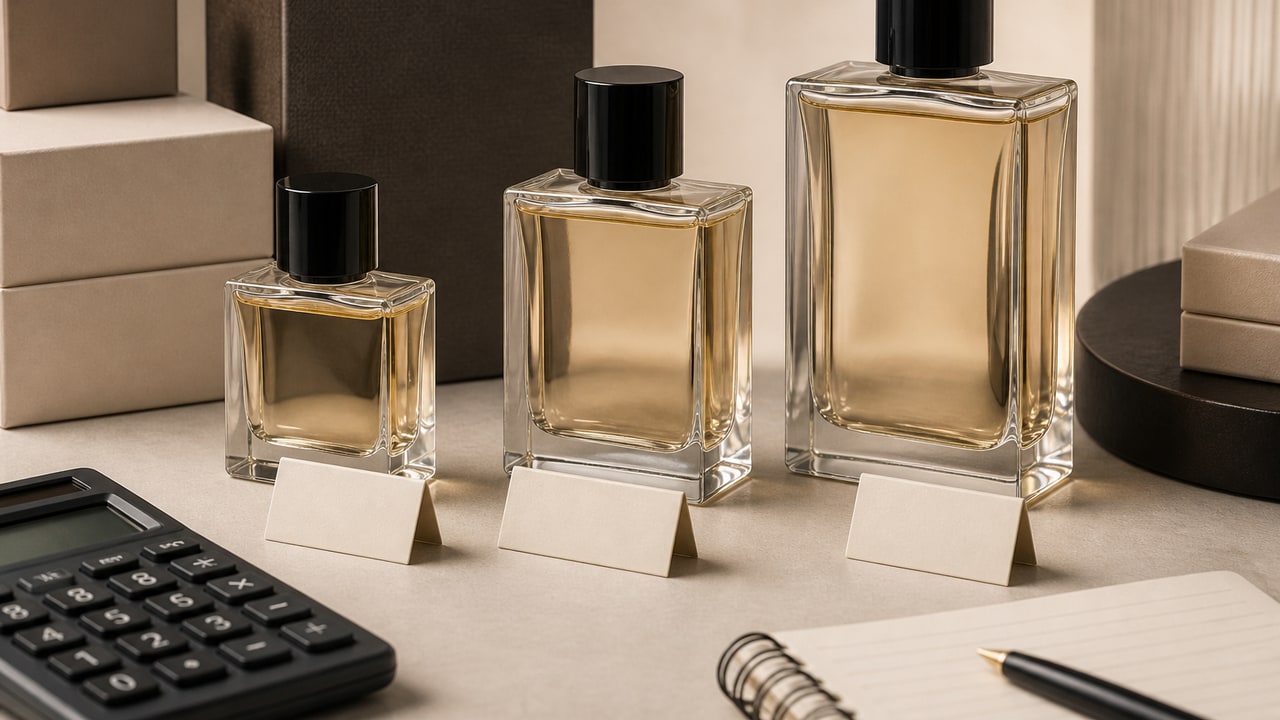
30ml, 50ml, or 100ml: Which Perfume Bottle Size Yields Higher Margins?

Comparison of 30ml, 50ml, and 100ml perfume bottle sizes for startup margin strategy

For most new fragrance brands, 50ml is the safest profit-and-cash-flow balance, 30ml often gives the highest percentage margin per ml, and 100ml usually delivers the highest absolute dollar profit per unit but with more inventory risk. WowSticker (wowsti.com) has years of factory-direct experience in custom labels, stickers, and packaging decoration for perfume and cosmetics brands worldwide, so this comparison looks at bottle economics the way buyers and founders actually need them: cost per ml, packaging share, turnover speed, and retail pricing logic. If you are deciding on perfume bottle sizes for startups, the fastest next step is to map your target retail price, MOQ, and packaging format before you lock the bottle. That prevents overspending on the wrong size in your first production run.

Need pricing for perfume bottle labels, cap badges, or premium decoration?

Send us your specs for Vinyl, UV DTF, or Nickel Stickers.

One common startup mistake is assuming the biggest bottle automatically means the best margin. In reality, the right answer depends on your sales channel, refill cycle, D2C shipping cost, and how quickly you need cash back from inventory. Global retail behavior also matters. As of 2025, 50ml and 100ml remain the standard full-size formats in the US and EU, while demand for 30ml-and-under “nomad” sizes has grown by about 25% year over year in North America and Europe, driven by younger buyers and travel-friendly purchasing habits. That makes bottle sizing a pricing strategy decision, not only a packaging decision.

What is the short answer on perfume bottle sizes for startups?

For most startup launches, 50ml is the best first full-size option, 30ml is the easiest premium-entry size, and 100ml works best after demand is proven.

Below is the practical comparison founders usually need first. It focuses on startup economics rather than consumer preference alone.

Feature 30ml 50ml 100ml
Typical startup role Entry luxury, travel, trial-to-full-size step Main launch size Anchor size or upsell for proven scents
Typical retail price band $45-$75 $68-$110 $98-$165
Margin per ml Highest Balanced Lowest per ml
Gross profit per unit Lower Medium to high Highest
Inventory risk Low Medium High
D2C shipping efficiency Best Good Weakest
Best use case New customer acquisition, travel retail, gifting Core line launch Top sellers, gifting, price ladder strategy

If the question is best perfume size to sell for a young brand with limited capital, the default answer is usually 50ml. It looks premium, keeps the shelf price reachable, and avoids tying too much cash into juice, glass, and freight. A 30ml line can outperform it in percentage margin, but average order value is lower. A 100ml bottle can look attractive on paper because the gross profit per unit is bigger, but slow turnover can hurt early-stage cash flow.

How do 30ml, 50ml, and 100ml compare on margin and cost per ml?

30ml usually has the strongest price-per-ml margin, 50ml gives the best overall balance, and 100ml has the best unit profit but the weakest cash efficiency for startups.

To make the economics easy to compare, the table below uses a planning model for an indie fragrance brand selling D2C or through boutique retail. These numbers are illustrative planning estimates based on common market pricing logic in 2025, not a formal quote for filling or glass supply. The goal is to compare unit economics, not to replace supplier quotations.

Size Estimated Total Unit Cost (USD) Suggested Retail Price (USD) Gross Profit per Unit (USD) Gross Margin Retail Price per ml
30ml $8.50-$12.50 $45-$75 $32.50-$66.50 72%-89% $1.50-$2.50
50ml $10.50-$15.50 $68-$110 $52.50-$99.50 77%-90% $1.36-$2.20
100ml $15.50-$23.00 $98-$165 $74.50-$142.00 76%-86% $0.98-$1.65
Budget Estimator Disclaimer: The prices shown above are planning estimates only and do not constitute a formal quotation. Actual prices vary by fragrance oil load, bottle weight, cap style, decoration, MOQ, compliance requirements, and destination. All figures shown in USD, converted at the reference rate of 7.20 RMB = 1 USD at time of writing.

The key pattern is simple:

This is why the 50ml vs 100ml perfume margin debate is often misunderstood. If you only measure gross profit per bottle, 100ml can win. If you measure cash returned per production dollar and inventory turnover speed, 50ml often wins for startups. If you measure margin per ml and accessibility for first-time customers, 30ml can win.

30ml: The entry-level margin tool

30ml is strong for brands that need a lower buy-in for first-time customers. It is also TSA-friendly, making it easier to position for travel and gifting. If your conversion challenge is getting people to try a new scent house, 30ml reduces buyer hesitation. The downside is that total dollar profit per order can stay low unless customers buy multiples.

50ml: The startup sweet spot

50ml is the most stable size in a typical fragrance bottle sizing strategy. It gives enough visual presence for premium shelf impact, enough liquid to justify a luxury story, and a realistic D2C price point. For many indie perfume brands, this is the best first SKU format because it balances margin, conversion, and replenishment speed.

100ml: The anchor and decoy

100ml works well when you want a higher-ticket option that makes the 50ml look more affordable by comparison. It can also be profitable for repeat customers who already trust the scent. But if your launch demand is uncertain, this size can trap more cash in stock and slow your ability to test new fragrances.

Want decoration pricing matched to your bottle size plan?

Send your size, MOQ, finish, and country for faster pricing on Vinyl Sticker, UV DTF, or Nickel Sticker options.

What does package cost look like by size, and how much does decoration matter?

Packaging cost usually takes a larger percentage of the selling price on smaller bottles, but decoration can still stay efficient if the design system is standardized.

For startup brands, packaging is not just a visual issue. It affects MOQ pressure, sampling cost, and first-run approval cost. Bottle, pump, cap, box, insert, and label all scale differently. The bottle and closure do not double in price just because volume doubles, which is why 100ml can look efficient on a pure packaging-per-ml basis. But packaging share of retail can still feel heavy if your sell-through is slow.

Package cost share by size

Cost Item 30ml 50ml 100ml
Bottle + pump + cap $1.80-$2.80 $2.20-$3.40 $3.20-$4.80
Folding box $0.45-$0.90 $0.55-$1.00 $0.75-$1.20
Label / decoration $0.03-$0.18 $0.03-$0.20 $0.04-$0.22
Approx. package cost as % of retail 5%-9% 4%-7% 4%-6%
Budget Estimator Disclaimer: These estimates are for planning only and are not a formal quotation. Actual package costs vary by bottle weight, cap material, print process, label finish, MOQ, and destination. All figures shown in USD, converted at the reference rate of 7.20 RMB = 1 USD at time of writing.

In the package cost structure, labels are usually one of the lowest-cost line items but one of the highest-impact visual details. For example, WowSticker pricing data shows a Vinyl Sticker at 50x30mm, 1,000 pieces, from about $18.29 total, or roughly $0.018 per piece. A comparable UV DTF Sticker at the same spec is about $48.30 total, or roughly $0.048 per piece. That difference matters if you are building three bottle sizes at once.

In terms of package cost share, no matter whether you choose 30ml, 50ml, or 100ml, using one unified design system across different-size Vinyl Sticker labels can reduce initial visual cost by combining sampling into one development workflow. For startups, this matters because the visual identity stays consistent across the line while the first-round design approval cost is easier to control. This is especially useful when the front label art stays identical and only the dimensions change for each bottle.

If your launch needs a premium tactile effect, Nickel Stickers or metallic badges can be reserved for gift sets or limited editions, while standard SKUs use Vinyl Sticker for lower setup risk. That mix is often more efficient than overdecorating every first-run bottle.

Product MOQ Unit Price (USD) Lead Time Notes
Vinyl Sticker 50x30mm 1,000 pcs $0.018 About 5-7 days Factory-direct reference based on 1 style
UV DTF Sticker 50x30mm 1,000 pcs $0.048 About 7-10 days Raised effect, stronger premium look
Budget Estimator Disclaimer: The prices shown above are auto-calculated by WowSticker's pricing engine for reference only. They are estimates for planning purposes and do not constitute a formal quotation. Actual prices vary by specs, MOQ, finish, and destination. All figures shown in USD, converted at the reference rate of 7.20 RMB = 1 USD at time of writing.

Why does 50ml usually outperform 100ml for startup cash flow?

50ml usually wins because it recovers cash faster, needs less liquid and packaging capital per unit than 100ml, and still supports premium pricing.

Margin is not only about what remains after one sale. It is also about how fast inventory turns. A startup with 1,000 units of 100ml can have stronger theoretical gross profit than the same brand with 1,000 units of 50ml, but it also has more money tied up in concentrate, alcohol base, glass weight, and freight. If sell-through slows by even 60 to 90 days, the larger bottle can become a burden.

That is why many niche fragrance brands launch only 50ml in year one. It is easier to position at $75 to $98 than $120 to $150 when customers do not yet know the brand. In boutiques, 50ml also works well as a gift purchase. In D2C, it usually sits in the psychological comfort zone between “too small to feel luxury” and “too expensive for a blind buy.”

Simple startup scenario

Assume a brand has a packaging and filling budget of $12,000 for one hero scent.

This is the operational reason many founders choose 50ml first. It protects margin quality without forcing large-bottle inventory risk too early.

How do shipping, compliance, and customer behavior affect the best perfume size to sell?

30ml is strongest for portability and low-friction trial, 50ml is strongest for balanced conversion, and 100ml faces more weight and blind-buy resistance in D2C channels.

Shipping cost and buyer psychology can easily change your preferred size. For direct-to-consumer fragrance brands, heavier packs increase both postage cost and breakage concern. A 100ml glass bottle with a heavy magnetic cap and rigid carton can add meaningful outbound shipping cost compared with a lighter 30ml or 50ml format. This matters even more for international parcels, where dangerous goods handling and destination restrictions can narrow courier options.

TSA and travel behavior also help 30ml. Buyers understand instantly that it is easy to carry, easy to gift, and less risky to try. This supports a high price per ml. Meanwhile, 50ml remains close enough to “full size” to justify a premium image. 100ml is often best for fans of an already successful scent rather than first-time buyers.

Real-world launch pattern in 2025

A practical pattern seen across indie perfume and cosmetics brands is:

This approach aligns with market behavior highlighted in North America and Europe, where discovery formats convert shoppers into later full-size purchases. For startups, that means the correct answer is often not one bottle size only, but a staged ladder.

What should startups send suppliers before asking for bottle decoration pricing?

The fastest quote comes from clear specs: size, MOQ, material, finish, application, and destination country.

Whether you are sourcing labels for 30ml, 50ml, or 100ml bottles, suppliers can price much faster when the scope is complete. This is especially important if you are comparing Vinyl Sticker, UV DTF, and metal-look options.

Quote Request Checklist for Perfume Bottle Decoration

  • Size / Dimensions: Label width x height in mm, and bottle size: 30ml, 50ml, or 100ml
  • MOQ: For example, 1,000 pcs, 3,000 pcs, or 10,000 pcs
  • Material Preference: Vinyl Sticker, UV DTF Sticker, Nickel Sticker, or mixed solution
  • Finish / Surface Treatment: Matte, gloss, metallic, embossed look, transparent, waterproof
  • Application Scenario: Perfume glass bottle body, cap top, gift box, sampler set
  • Delivery Country: US, UK, UAE, France, Australia, etc.

Have your bottle sizes and artwork ready?

Share your dimensions, MOQ, and destination to get a faster quote on factory-direct decoration.

What is the best fragrance bottle sizing strategy for a new brand?

The strongest launch blueprint is usually 50ml as the core line, 30ml or discovery sizes for acquisition, and 100ml only after top scents prove repeat demand.

For most founders, the answer is not to maximize theoretical margin on a spreadsheet. It is to choose a bottle system that supports first purchase, repeat purchase, and healthy cash rotation. If you are building a luxury image, 50ml is the most reliable first full-size. If your brand story depends on portability, gifting, or lower trial resistance, add 30ml early. If your fragrance already has traction, 100ml can raise order value and strengthen tiered pricing.

This is the core of a good fragrance bottle sizing strategy. Start with the bottle that the market can absorb fastest. Then expand size architecture after you understand your repeat rate, return rate, and top-SKU performance. That is usually more profitable than launching all three sizes at equal weight from day one.

WowSticker sees this logic often in perfume and cosmetics packaging projects: brands that standardize their front label system, box visual language, and cap-top decoration across sizes can expand faster with less design waste. That is especially true when one visual concept is adapted into different-size Vinyl Sticker applications rather than rebuilt from zero for every SKU.

Practical conclusion: if you are choosing among 30ml, 50ml, and 100ml for a first launch, start with 50ml unless your brand depends on travel convenience or very low entry pricing. Add 30ml to improve conversion and discovery. Introduce 100ml later for proven best-sellers and price-ladder strategy.

FAQ

What is the best perfume bottle size for a new fragrance brand to launch with?

For most startups, 50ml is the best first full-size launch. It balances luxury positioning, conversion, and inventory risk better than 100ml, while giving a stronger premium feel than 30ml. If budget is tight, pair 50ml with a smaller discovery format later instead of launching all sizes at once.

Which is better for startup margins: 50ml or 100ml?

50ml is usually better for startup cash-flow margin, while 100ml often gives higher gross profit per unit. If your brand is new and demand is not proven, 50ml is safer because it ties up less capital and usually turns faster. If you already have strong repeat customers, 100ml can add profit efficiently.

Which is better for customer acquisition: 30ml or 50ml?

30ml is better for first-time trial and travel positioning because the entry price is lower and the format feels less risky. 50ml is better if you want one main SKU that still feels premium. Many startups use 30ml to attract new buyers, then push repeat purchases toward 50ml.

Is it more profitable to sell 50ml or 100ml perfumes?

It depends on what you mean by profitable. 100ml often has the highest absolute dollar profit per bottle, but 50ml can be more profitable operationally because it needs less upfront investment and usually sells faster. For a new D2C fragrance business model, speed of sell-through often matters more than theoretical unit profit.

How do TSA regulations impact the best perfume sizes to sell?

TSA-friendly sizing helps smaller formats, especially 30ml and under, because buyers see them as travel-safe and easy to carry. That increases convenience value and supports a higher price per ml. While 50ml can still sell well, 30ml is often easier to market for travel, gifting, and impulse purchase.

Why do so many niche perfume brands only offer 50ml bottles?

Because 50ml is often the most efficient compromise between shelf appeal, luxury pricing, and startup inventory risk. It is easier to blind-buy than 100ml and feels more substantial than 30ml. For niche brands that need premium positioning without excessive working capital, 50ml is a practical standard.

What should I send before asking for a quote on perfume bottle labels?

Send your bottle size, label dimensions in mm, MOQ, material choice, finish, application area, and delivery country. If you already know whether you want Vinyl Sticker, UV DTF, or Nickel Sticker, mention that too. Complete quote inputs reduce back-and-forth and make sampling faster.